





Financial Analyst/Content Writer, RADEX MARKETS
Lawrence J. came from a strong technical and engineering background before pivoting into a more financial role later on in his career. Always interested in international finance, Lawrence is experienced in both traditional markets as well as the emerging crypto markets. He now serves as the financial writer for RADEX MARKETS.


AKTIEN


The northern hemisphere has passed the halfway point of summer, and Europe is currently suffering through one of its hottest and driest periods on record. Grass has turned to straw; soil has dried to dust; riverbeds are being exposed for the first time in generations and reservoirs are emptying at dizzying rates. People throughout the continent are starting to question whether rain ever existed at all and the skies refuse to conjure up a single drop of pluvial mercy.
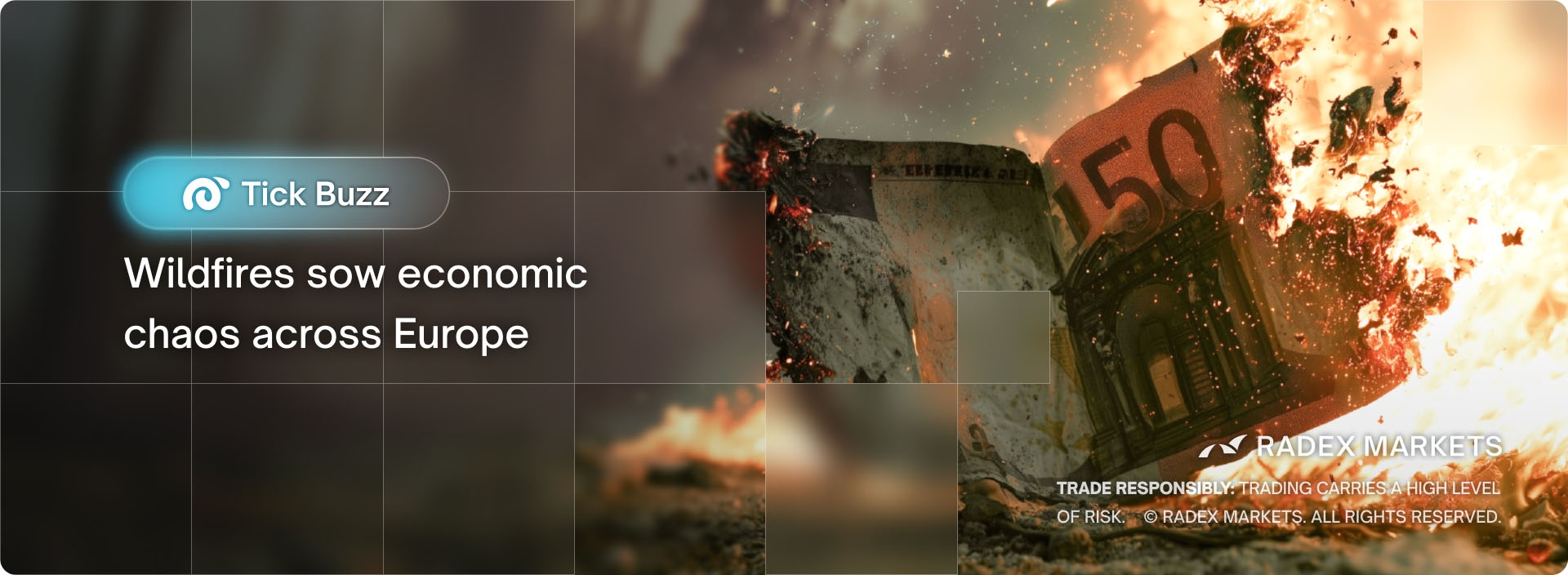
The arid conditions have inevitably paved the way for wildfires, which have engulfed vast swathes of Spain, France, Greece and other parts of Europe. Over one million acres of land have been ravaged by the unstoppable inferno – an area three times the size of greater London – prompting evacuations for tens of thousands of people.
The economic damage caused by the wildfires amounts to around $20 billion according to some estimates, with the bulk of that figure being contributed by the situation unfolding in southwest France. Over 40,000 businesses have been impacted in the Bordeaux region alone, with around half of those closing completely. The area is well known for tourism and winemaking, but it is also home to a number of heavy industrial firms, including Dassault Aviation, Ariane and Safran. Over 100,000 employees have been unable to safely commute to work because of the wildfires and reduced air quality, leading to further economic downturn.
In central Spain, around 150 km north of Madrid, the fires have caused widespread damage to vineyards, with some estates reporting the loss of agricultural lands that date back to the 1920s. Most of the damage so far has been minimal and very few vines will need total replacement, which is fortunate because such a process can take ten years to get back up to full yield. The bigger problem is the smoke from the fires, which can cause contamination of the grape skin, potentially wiping out all revenue for the year. Grazing pastures have also been affected by the fires, consuming lands that would normally feed thousands of head of livestock, forcing farmers to buy expensive imported feed.
The forestry industry is experiencing a similar degree of pain, as fires rip through forests that would normally supply the local timber markets. Millions of cubic metres of harvestable wood have gone up in flames, causing long-term raw material shortages for construction and paper manufacturing. The forestry, wood and paper industries typically generate $10 billion in annual turnover in southwest France, but many of the trees fuelling the sector have been reduced to ashes. Moreover, soot and toxic ash runoff from coastal fires have polluted many of the waterways necessary for aquaculture, wreaking havoc in seafood supply chains.
France, Spain and Greece all see large seasonal influxes of tourists, but recent natural disasters have made many travellers think twice about their holiday plans. Bookings are seeing waves of cancellations in light of recent events, and the local economies are suffering as a result. With that said, the loss in tourism revenue has been strictly contained to the affected areas, with the wider industry remaining relatively unaffected by the ongoing wildfires.
In eastern Europe, extreme weather conditions have destroyed millions of tonnes of grain, resulting in billions of Euros in financial losses. Fast moving fires have destroyed barns, feed warehouses and grazing pastures, while major roads and commercial check points have been forced to close, slowing down shipments of perishable goods. Meanwhile, water levels in major European rivers have fallen so low that a number of power plants have had to shut down due to insufficient cooling. France, Italy, Poland, Hungary, Romania and Slovenia have all seen plant closures, leading to increased strain on the electrical grid. Agricultural destruction, supply disruption and higher energy prices are all contributing to a surge in inflation across Europe, especially in the south and east of the continent.
Healthcare spending has dramatically increased as a result of the toxic wildfire smoke that is blanketing certain areas, sometimes travelling thousands of kilometres beyond the sites of the fires themselves. Hospital admissions are up as a result of increased cases of respiratory failure, asthma attacks and strokes, leading to stress on healthcare and emergency services.
The recent wildfires have raised the question of the “protection gap” in the affected regions, whereby many European assets are not properly insured against natural disasters. Some of Europe biggest insurance companies have warned about the lack of coverage and have made attempts to make governments more aware of the problem. As it stands, progress has been slow and insurance firms still have very little exposure to the events at hand. Wildfire risk management is much more developed in the US and Australia, whereas European insurance frameworks are somewhat immature in comparison. According to the European Central Bank, only 25% of climate-related losses in Europe are currently covered by insurance, compared to around 50% in Australia and 65% in the United States.
About the Author
Lawrence J. came from a strong technical and engineering background before pivoting into a more financial role later on in his career. Always interested in international finance, Lawrence is experienced in both traditional markets as well as the emerging crypto markets. He now serves as the financial writer for RADEX MARKETS.
Reviewed by RADEX MARKETS
Risk Warning: Trading derivatives and leveraged products carries a high level of risk, including the risk of losing substantially more than your initial investment.


Der Handel mit Derivaten und gehebelten Produkten ist mit hohen Risiken verbunden und kann zu Verlusten führen, die Ihre ursprüngliche Investition übersteigen. Lesen Sie vor dem Handel unsere Allgemeinen Geschäftsbedingungen (T&C) sowie das Product Disclosure Statement (PDS).
KONTO ERÖFFNEN