



Financial Analyst/Content Writer, RADEX MARKETS
Lawrence J. came from a strong technical and engineering background before pivoting into a more financial role later on in his career. Always interested in international finance, Lawrence is experienced in both traditional markets as well as the emerging crypto markets. He now serves as the financial writer for RADEX MARKETS.


AKTIEN


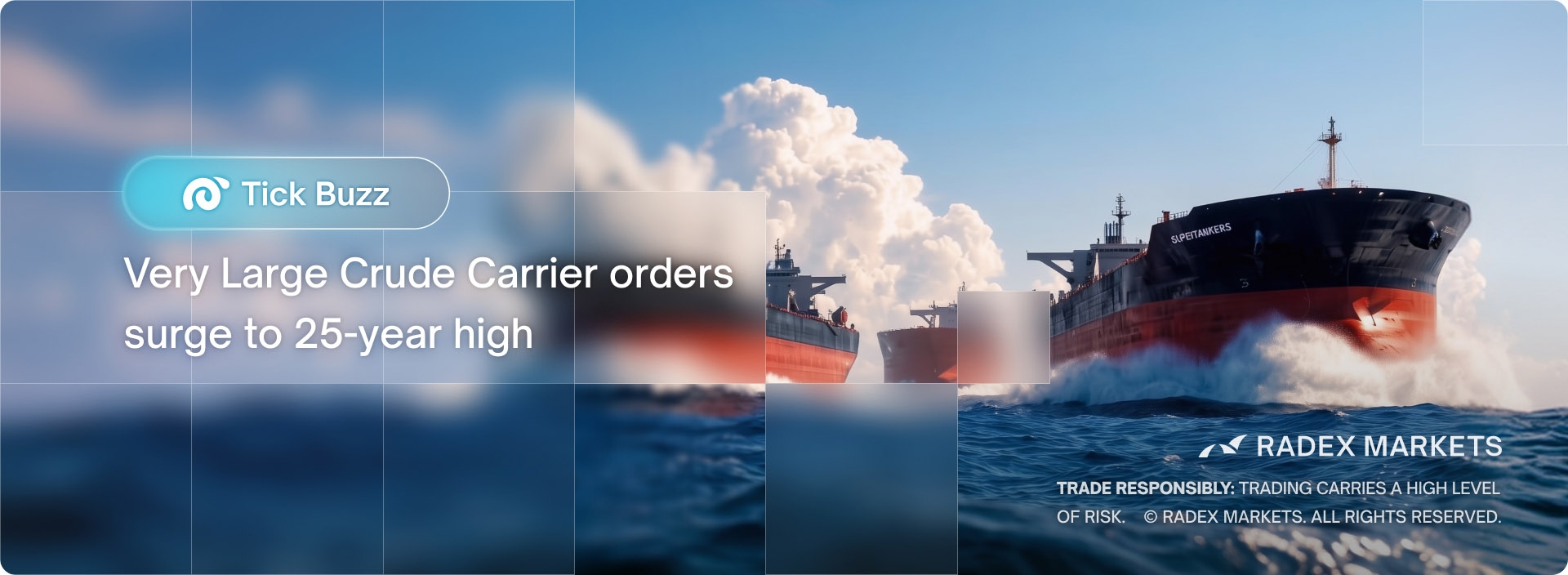
Orders of Very Large Crude Carriers (VLCCs) have surged to a 25-year high in 2026, as global ship owners rush to commission new supertankers.
With three months to go before the end of the year, 217 VLCCs have already been ordered so far, which is more than double the 93 total orders in 2025.
With price tags for new vessels running at around $130 million apiece, the total order volume is rapidly approaching $30 billion, demonstrating how desperate shipping companies are to secure more freight capacity. The backlog in shipping yards around the world has now reached over 250 ships – the largest number since before the 2008 financial crisis.
The spike in demand for oil tankers may seem counterintuitive given the unwillingness of vessels to go anywhere near the Strait of Hormuz, but the ongoing conflict in the Middle East is in fact the major catalyst behind the recent surge in VLCC orders.
With Gulf deliveries proving to be unreliable, buyers in Europe and Asia have been forced seek out alternative sources of crude oil and substitute shipping routes via which to secure them.
The Atlantic Basin has stepped up to the task. Shipments from the US Gulf Coast to Asia have seen massive increases in volume over the last few months, with US exports hitting consecutive monthly records throughout the second quarter of this year. Brazil, Guyana, Venezuela and parts of West Africa have likewise seen a huge surge in demand for their precious resources.
The obvious problem is that for buyers in Asia in particular, these Atlantic oil fields are much further away, adding thousands of kilometres to the normal shipping routes.
A typical journey from the southern loading terminals in Iraq, through the Persian Gulf, across the Indian Ocean, through the Malacca Strait and up to Japan is around 6,600 nautical miles. A typical VLCC maxes out at around 15 knots on a good day, meaning a one-way trip on such a route would take about 20 days, including loading, customs and everything else. In contrast, a tanker setting out from the US Gulf Coast would have to cover 15,000 nautical miles to reach the same destination, which could take well over 45 days.
Sticking with Japan as an example, the island nation consumes about 3 million barrels of oil per day. Modern supertankers carry up to 2 million barrels, meaning a full shipment is only enough to provide 16 hours of fuel. Japan therefore needs a constant stream of tankers arriving at its shores every single day in order to maintain a steady supply of energy and petroleum products.
This is where adding additional distance to the supply chain creates problems. Most nations around the world require a never-ending chain of supertankers in order to function, but the longer the chain becomes, the more ships are required to complete it. The inescapable mathematical problem is that doubling the distance doubles the necessary number of ships.
This is why orders have skyrocketed. Shipping routes are now thousands of nautical miles longer than they used to be, and shipping companies do not have large enough fleets to fill the gap.
The lack of available ships has sent the cost of chartering a VLCC through the roof – more than tripling according to some reports – awarding ship owners the massive amounts of cash necessary to expand their fleets.
The sudden windfall is also allowing shipping conglomerates to prematurely retire some of their older tankers in favour of more modern, fuel-efficient ships that comply with stricter environmental regulations.
The crucial aspect of all of this is that Very Large Crude Carriers take several years to build and are designed to operate for 20-25 years. This means that the people commissioning these vessels are expecting them to still be active in the 2050s. These companies do not spend billions of dollars on a whim. If the conflict surrounding Iran is destined to be short-lived, then why the colossal investment in new ships?
The decision makers at the top seem to be anticipating a permanent change in the way the global oil trade functions. The major oil producers of the past may not be those of the future. The landscape has already changed significantly due to the fracking boom in the Permian Basin, turning the United States into a net exporter of crude oil almost overnight. As a result of the recent change of leadership in Caracas, countless billions of dollars are now waiting to be deployed on new developments in the largely untapped oil fields of Venezuela. Brazil now produces 4.5 million barrels per day, rivalling Iraqi output even before recent hostilities curbed production. Guyana is another miraculous story, going from precisely zero barrels in 2019 to almost 1 million BPD in 2026. From small island nations in the Caribbean to huge territories on the west coast of Africa, the region is buzzing with activity.
Over the next two decades, virtually all global crude extraction growth is expected to occur in the Atlantic Basin. Shipping companies are positioning themselves accordingly.
About the Author
Lawrence J. came from a strong technical and engineering background before pivoting into a more financial role later on in his career. Always interested in international finance, Lawrence is experienced in both traditional markets as well as the emerging crypto markets. He now serves as the financial writer for RADEX MARKETS.
Reviewed by RADEX MARKETS
Risk Warning: Trading derivatives and leveraged products carries a high level of risk, including the risk of losing substantially more than your initial investment.


Der Handel mit Derivaten und gehebelten Produkten ist mit hohen Risiken verbunden und kann zu Verlusten führen, die Ihre ursprüngliche Investition übersteigen. Lesen Sie vor dem Handel unsere Allgemeinen Geschäftsbedingungen (T&C) sowie das Product Disclosure Statement (PDS).
KONTO ERÖFFNEN