



Financial Analyst/Content Writer, RADEX MARKETS
Lawrence J. came from a strong technical and engineering background before pivoting into a more financial role later on in his career. Always interested in international finance, Lawrence is experienced in both traditional markets as well as the emerging crypto markets. He now serves as the financial writer for RADEX MARKETS.


COMPARTIR


Indonesia is currently battling its worst wildfire season in a decade. Millions of hectares of highly flammable peat swamp have been burning for months, devastating the islands of Borneo and Sumatra, and blanketing much of South-East Asia in thick, toxic smog.
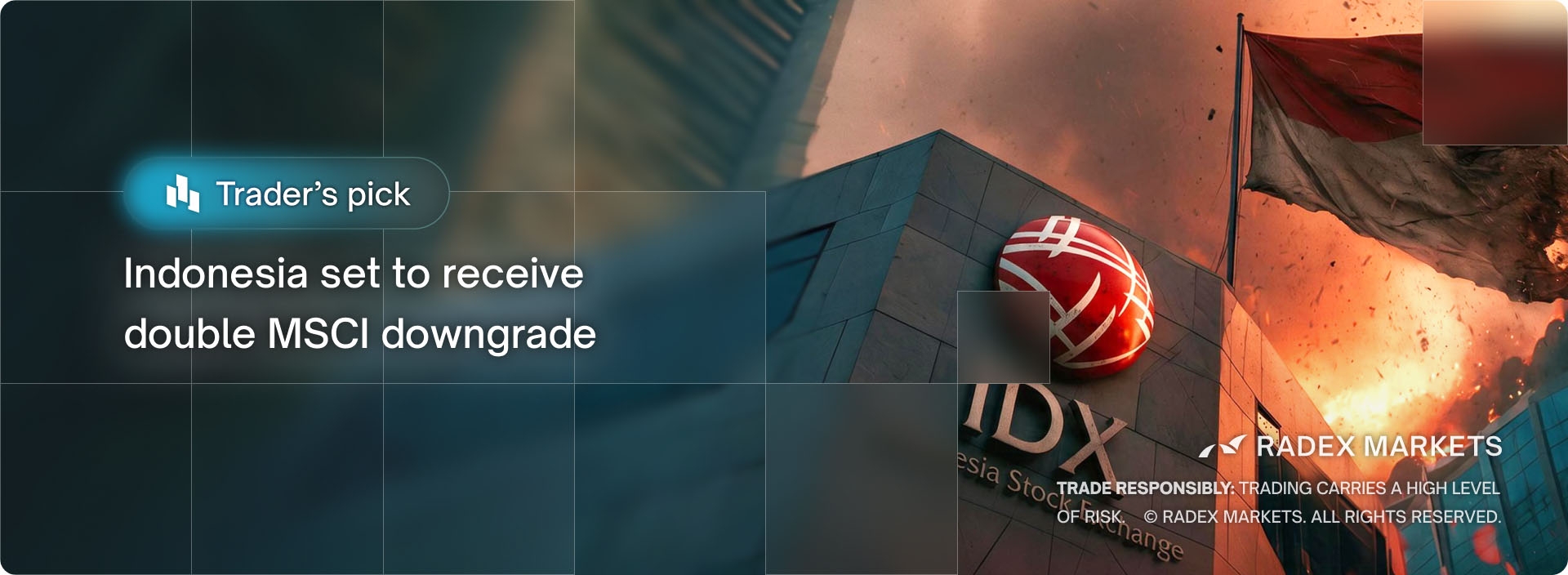
Unfortunately for Indonesia, its agricultural lands are not the only part of the country in flames. The Indonesian stock market was set ablaze late last week after MSCI – formerly Morgan Stanley Capital International – announced that it would launch a consultation to downgrade Indonesia’s market classification from ‘emerging’ to ‘standalone’.
The announcement triggered a 15% selloff in the IDX Composite last week, marking the worst weekly downturn for the index since the 1998 Asian financial crisis.
MSCI routinely revises the status of different countries, reflecting their changing economic and financial conditions, but as a rule, downgrades are uncommon. What makes the Indonesia downgrade even more surprising is that MSCI will potentially demote the country by two full ranks instead of one.
The MSCI classification is not a reflection of the size or strength of a given country, but rather an indication of how easy it is for foreign capital to invest in its domestic market. The classification has four separate ranks:
Developed markets: highly developed economies, at least five companies with large market caps and trading volumes, unrestricted foreign access and fully convertible currencies. E.g.: United States, United Kingdom, Japan, etc.
Emerging markets: three large companies required, decent accessibility to foreign investors but with notable exceptions. E.g.: Brazil, Greece, China, etc.
Frontier markets: only one large company necessary, at least partial capability of moving capital in and out of the country. E.g.: Iceland, Vietnam, Kenya, etc.
Standalone markets: isolated, difficult to invest, typically plagued by strict capital controls.
Indonesia’s downgrade, if implemented, would relegate the country to the absolute lowest ranking within the system.
The IDX Composite has been in a prolonged drawdown since the start of the year. The index successfully breached 9,000 points back in January, but saw lows of just 4,900 points this week as a result of the proposed downgrade.
It was in fact a similar announcement that triggered the initial selloff earlier in the year, when MSCI issued a warning to clients regarding the integrity of the Indonesian stock exchange. Opaque corporate ownership structures, price manipulation and insider trading were all cited as reasons for concern, prompting billions of dollars in foreign capital to withdraw and reduce their exposure to the apparent structural risk.
The subsequent oil crisis did even more damage during the spring months, erasing the country’s trade surplus and draining Indonesia’s dollar reserves, tanking the local currency in the process. Aggressive spending policies by the current administration have also set alarms bells ringing, lifting the debt service ratio to a staggering 36%, meaning over a third of Indonesia’s foreign revenue goes straight to repaying external debt obligations.
A double demotion in the MSCI ranks is an extremely rare event, occurring only five times in the last 25 years.
Russia suffered the same fate back in 2022 following harsh international sanctions and retaliatory capital controls. Argentina was also demoted to standalone status after the government imposed strict capital controls in 2021. Venezuela, Pakistan and Sri Lanka were also thrown to the back of the bus at various points, for much of the same reasons. In all cases, the MSCI’s own rulebook forced the company into performing the downgrades, due to the complete freeze on foreign capital entering or exiting the markets in question.
Indonesia’s situation is different. The Indonesian government is not implementing capital controls, nor is the country subject to international sanctions, nor are price floors being enforced. The problem is simply that the entire stock market is a financial hall of mirrors because no one knows the fair value of any of the companies listed within it. Massive conglomerates claim to have large public floats on paper, but in reality, most of the shares are held by founders, shell companies and hidden affiliates. In such low-liquidity conditions, wash trading become very easy. A small number of market participants were able to manipulate prices to entirely fictional levels, tricking foreign funds into buying ridiculously inflated assets. To make matters worse, local regulatory bodies turned a blind eye to all of the above, eventually causing analysts at MSCI to collectively throw up their hands in frustration.
Once foreign institutional money realised that it had been duped, everyone ran for the exit, hence the 15% collapse observed last week.
MSCI will not perform the actual downgrade until mid-2027. The Indonesian government has until then to provide concrete proof that is has successfully eradicated the opaque ownership structures and wash trading practices. Should it fail to do so, the demotion will likely proceed as announced. In the meantime, Indonesian stocks will essentially be quarantined from global markets until a decision has been reached.
About the Author
Lawrence J. came from a strong technical and engineering background before pivoting into a more financial role later on in his career. Always interested in international finance, Lawrence is experienced in both traditional markets as well as the emerging crypto markets. He now serves as the financial writer for RADEX MARKETS.
Reviewed by RADEX MARKETS
Risk Warning: Trading derivatives and leveraged products carries a high level of risk, including the risk of losing substantially more than your initial investment.


Operar con derivados y productos apalancados implica un alto riesgo y puede resultar en pérdidas superiores a su inversión inicial. Lea nuestros Términos y Condiciones (T&C) y la Declaración de Divulgación del Producto (PDS) antes de operar.
ABRIR CUENTA