





Financial Analyst/Content Writer, RADEX MARKETS
Lawrence J. came from a strong technical and engineering background before pivoting into a more financial role later on in his career. Always interested in international finance, Lawrence is experienced in both traditional markets as well as the emerging crypto markets. He now serves as the financial writer for RADEX MARKETS.


AÇÃO


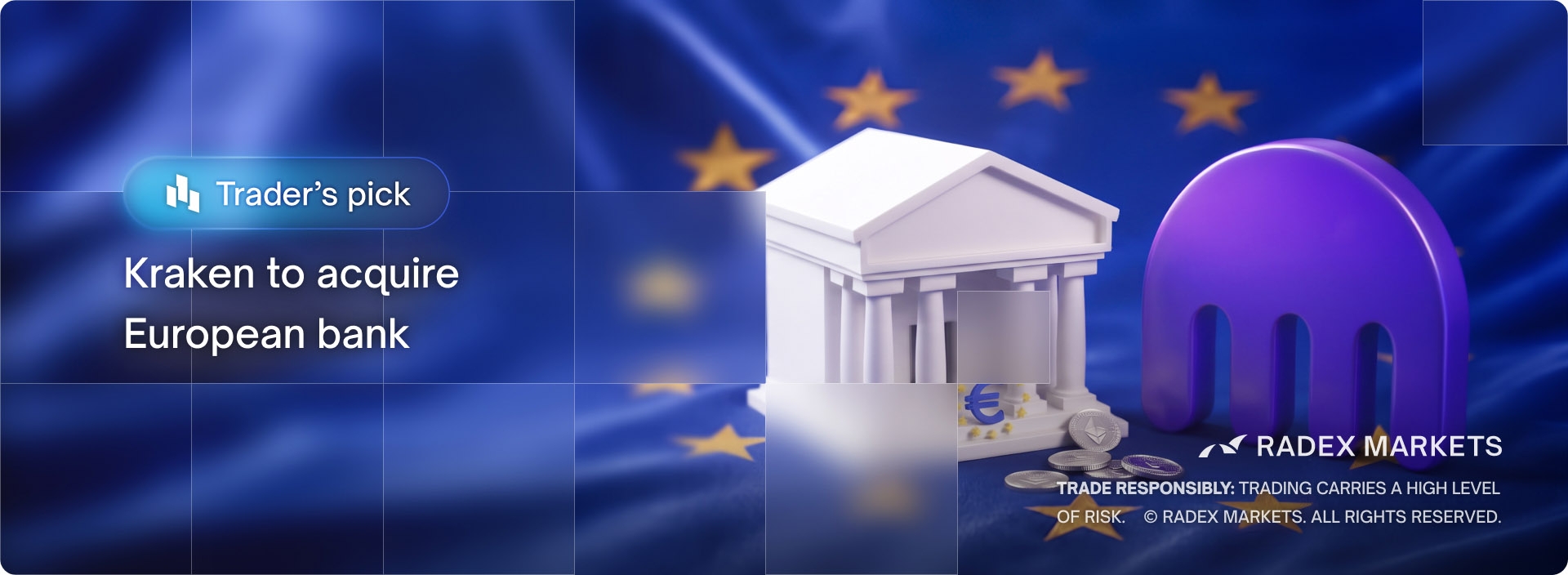
In a milestone deal announced on Wednesday, Payward Inc., the parent company of US cryptocurrency exchange Kraken, signed an agreement to acquire Lithuania-based Saldo Bank.
The deal, if completed, would represent the first acquisition of a commercial bank based within the European Union by a crypto-native company.
Saldo Bank is a CRD credit institution, as regulated under the EU’s Capital Requirements Directive, meaning it can legally handle yield-bearing bank deposits and lending operations. Such privileges would subsequently fall to Kraken, thereby awarding the crypto company direct access to customer deposits for the first time.
Beyond Lithuania, the acquisition would immediately open the door to a number of other European markets, including Finland, Sweden, Germany, and the Netherlands.
Payward has spent years aggressively compiling a massive stack of financial regulations and registrations, spanning hundreds of jurisdictions and geographical regions throughout the world. The firm holds a special purpose Federal Reserve charter in its home state of Wyoming, allowing it to interface directly with dollar payment systems without relying on third-party intermediaries.
In Europe, Kraken holds Electronic Money Institution (EMI) and Markets in Crypto-Assets (MiCA) licences via the Central Bank of Ireland, as well as the equivalent licences in the United Kingdom via the Financial Conduct Authority. Further afield, various registrations extend the company’s sphere of influence all the way from the US to Dubai to Australia.
The novel deal perfectly exemplifies what happens when the crypto industry is backed into a legal corner: rather than endlessly waiting for approval, companies are simply buying out the necessary licences.
It is no secret that cryptocurrencies have been bogged down in a regulatory quagmire for many years, facing unfair scrutiny and punitive measures while receiving next to nothing in terms of constructive guidance. The recent failure of the Clarity Act to pass through US Congress is merely the latest example in a long chain of proverbial kicks in the teeth.
The problem is simply that crypto firms are not allowed to offer the same services as traditional financial institutions. The obvious solution of acquiring banking charters did not work because such licences were continuously denied. The frustration has built up to the point where crypto companies are now buying existing financial infrastructure, bypassing the stubborn legal gatekeepers.
Another problem is the issue of fiat on/off ramps. Crypto exchanges are entirely dependant on traditional banks to handle client deposits and withdrawals, which constitutes a huge architectural choke point, leaving them exposed to the possibility of being ‘de-banked’. Buying a fully licenced bank completely nullifies such threats.
To play devil’s advocate for a minute, the US Office of the Comptroller of the Currency (OCC) has in fact changed its tune in recent times, granting conditional banking charters to no fewer than 12 crypto and fintech companies so far this year. Unfortunately, these conditional charters do not grant the same rights as full banking charters, such as housing customer cash balances, which is precisely why Kraken is seeking to purchase a bank of its own.
The acquisition of Saldo Bank still needs the green light from the European Central Bank, which will deliberate the matter over the next 3 to 6 months. Chances of outright rejection are low, although Kraken will have to prove that Saldo’s balance sheet is insulated from its other liabilities, while the capital used for the purchase will have to be provably clean.
Crypto firms have tried for years to ingratiate themselves within the correct regulatory circles, to no avail. Denying companies that apply for banking licences is easy, ignoring them when they outright buy those licences is another matter. The new approach was perfectly predictable.
About the Author
Lawrence J. came from a strong technical and engineering background before pivoting into a more financial role later on in his career. Always interested in international finance, Lawrence is experienced in both traditional markets as well as the emerging crypto markets. He now serves as the financial writer for RADEX MARKETS.
Reviewed by RADEX MARKETS
Risk Warning: Trading derivatives and leveraged products carries a high level of risk, including the risk of losing substantially more than your initial investment.


A negociação de derivados e produtos alavancados envolve elevado risco e pode resultar em perdas superiores ao seu investimento inicial. Leia os nossos Termos e Condições (T&C) e a Declaração de Divulgação do Produto (PDS) antes de negociar.
ABRIR UMA CONTA