





Financial Analyst/Content Writer, RADEX MARKETS
Lawrence J. came from a strong technical and engineering background before pivoting into a more financial role later on in his career. Always interested in international finance, Lawrence is experienced in both traditional markets as well as the emerging crypto markets. He now serves as the financial writer for RADEX MARKETS.


CHIA SẺ


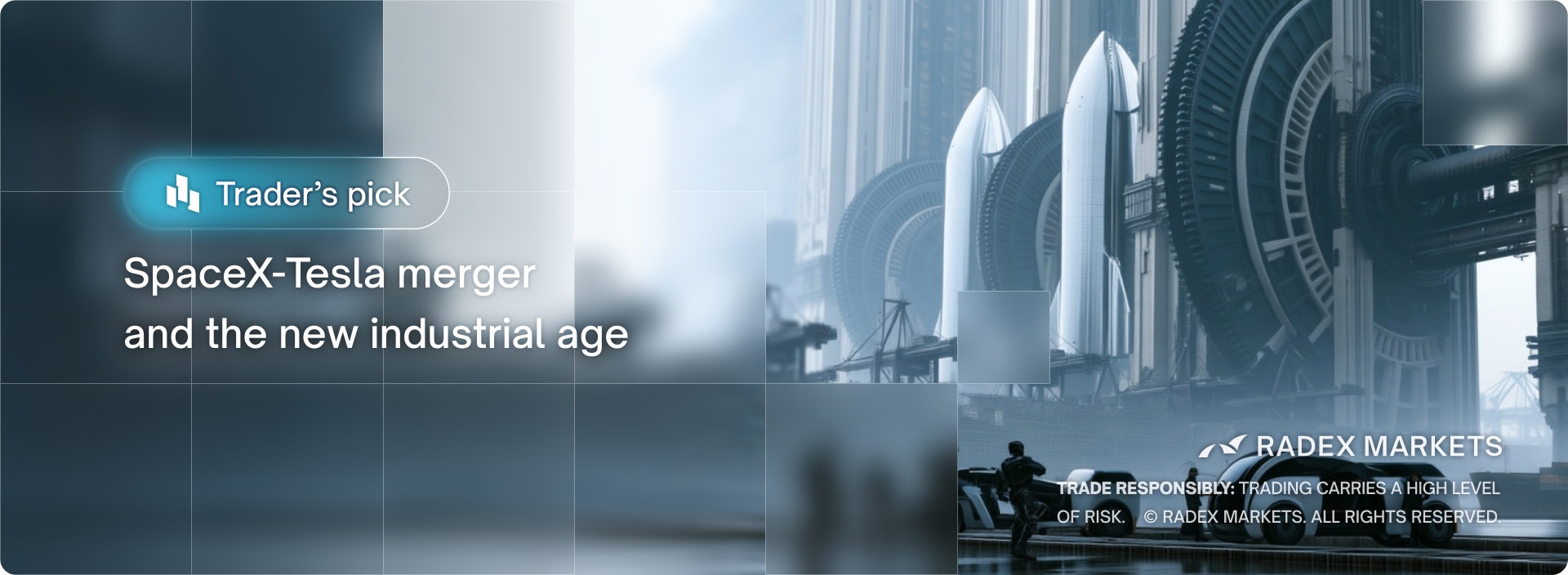
Wall Street is buzzing with rumours of a potential merger between SpaceX and Tesla, in what could be the single largest integration of its kind in the modern era. SpaceX completely obliterated investor expectations in recent weeks, publishing a bombshell earnings report that revealed a massive jump in revenue and a staggering $4.4 billion in net income. Markets are quickly realising that the space faring company has more to offer than rockets, and in fact SpaceX is already emerging as one of the major hyperscalers, joining the ranks of Google, Meta, Microsoft and Amazon in providing mass cloud computing and artificial intelligence services. Elon Musk now predicts the company will rake in up to $1 trillion in annual recurring revenue by the end of 2027, prompting investors to completely revise their growth forecasts.
The Super Intelligence division of SpaceX is hugely profitable, but so too is the Starlink satellite business. Each of these enterprises represent huge accomplishments in their own right, but they are merely divisions of a larger rocket and orbital freight company. The profits generated by the peripheral elements of the business are funnelled straight into novel rocket and spaceship designs, pushing SpaceX to technological leap after technological leap. Add an electric car company into the mix and the picture broadens even further.
The world is beginning to witness the birth of the kind of megacorporation that is normally confined to works of science-fiction. Multi-industry, globe-spanning entities are a common trope in far-future world-building, such as the Tyrell Corporation in Bladerunner, Weyland-Yutani in the Alien saga, the Umbrella Corporation in Resident Evil, Mao-Kwikowski Mercantile in the Expanse, or even Shinra Electric Power Company in FFVII. There are so many examples to list, throughout various franchises and different media, that such consolidated megacorporations seem like a foregone conclusion in our own world. There are good reasons to believe this may indeed be the case.
Typically, the larger a company becomes, the harder it is for smaller competitors to catch up, simply by virtue of scale. If one player can afford to spend billions of dollars on infrastructure and one cannot, the former necessarily gains the upper hand. Moreover, as is the case with SpaceX, one division of the company can fund a completely separate venture, granting vast sums of cash that would not otherwise be available, and at basically no cost.
The other side of this dynamic is the structural inflexibility that typically arises as companies scale to new heights. Bureaucracy takes hold, communication breaks down, bloated departments create inefficiencies and decision-making grinds to a halt. German car companies illustrate the problem well enough. To make matters worse, government bodies will sometimes step in to regulate and break up perceived monopolies, erecting artificial barriers to consolidation. The above issues can, and do, allow more nimble startups to disrupt the playing field, resulting in a chaotic balancing act between the old guard and the new.
This is where a new spanner gets thrown into the works. As AI continues to gain ground, many of the human elements of the equation will be removed. It follows that many of the structural disadvantages of large employee counts will also be removed.
What happens to the scaling problem when a component is entirely designed by AI, before the schematic is sent off to an automatic machining factory, then shipped to a similarly independent testing facility, and finally transported to a client via autonomous transport, all with no delay, no rest time, and no human concerns to address? What happens when billion-dollar corporations become immune from government intervention because they only have handful of employees on their payroll? By the time the regulations catch up, it is far too late.
There are many barriers preventing a SpaceX-Tesla merger. National security is the big one; SpaceX works directly with NASA and the Pentagon and routinely handles classified information. This is a problem because Tesla relies on China for over half its global vehicle production. Shareholder voting is also a major hurdle because the decision to merge would depend on securing the consensus of a majority of all outstanding shares, which presents a huge logistical task even if such an agreement were indeed forthcoming. The final problem is of course that of regulatory watchdogs shutting down the merger on anti-competition grounds.
The final point raises the interesting question of just how much longer governments will be able to wield such power. There are no models for the kind of hyperbolic growth exhibited by AI technology. By the time the people in charge figure out what is going on, they may no longer be in any position to do anything about it.
Every previous industrial revolution was ushered in after technological breakthroughs allowed humanity to drastically increase its output via automation. The first industrial revolution introduced steam and coal to automate heavy machinery. The second brought about electricity to automate entire production lines. The third automated data and information transmission. The fourth is about to automate cognition itself.
Non-linear positive feedback loops are difficult for the mind to grasp. Human technological advancements have never been gradual, they have always occurred in sudden bursts of innovation, but the next leap forward may be the most aggressive yet. A company that does everything from AI to telecoms to cars to spaceships, while earning hundreds of billions of dollars in the process, will not simply wait around, nor will it ask for permission before acting.
Megacorporations already have real-world equivalents, albeit in limited form, in the likes of the massive companies found in Japan and South Korea, and increasingly in China. In Japan, Zaibatsu (roughly translated as ‘asset clique’) have long been the main economic drivers of the island nation, covering everything from coal mining to heavy manufacturing to banking and insurance. Companies such as Mitsubishi perfectly exemplify this, with branches in finance, heavy industry, car manufacturing and consumer electronics. The South Korean ‘Chaebol’ is essentially the same structure.
Whereas in the West such monopolies were routinely dismantled to promote domestic competition, in the East these super-conglomerates were actively encouraged by their respective governments so that they could fight for larger shares of the global economy. The end result of the difference in approach is that a company like Mitsubishi wields far greater local government power, while a company like Google influences the world from an entirely commercial angle. In Japan, government and business interests are usually aligned; in the US, the government and major companies are often at each other’s throats.


Trading derivatives and leveraged products is high risk and may result in losses exceeding your initial investment. Read our T&C and PDS before trading.
MỞ TÀI KHOẢN