





Financial Analyst/Content Writer, RADEX MARKETS
Lawrence J. came from a strong technical and engineering background before pivoting into a more financial role later on in his career. Always interested in international finance, Lawrence is experienced in both traditional markets as well as the emerging crypto markets. He now serves as the financial writer for RADEX MARKETS.


ACTIONS


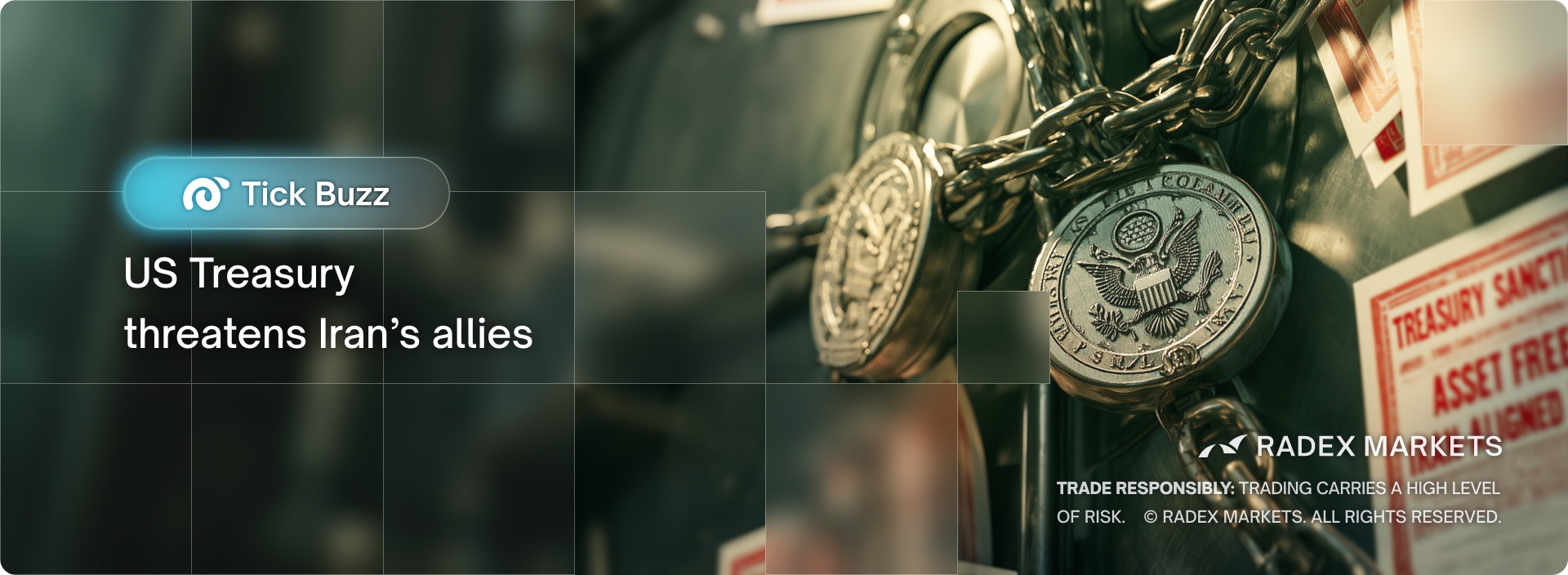
On Monday, Treasury Secretary Scott Bessent laid out the next stage of economic measures directed at Iran. Interestingly, rather than impose sanctions on Iran itself, Bessent was more interested in addressing the regime’s trading partners, threatening to financially isolate anyone seeking to maintain ties with the war-torn country.
Yesterday’s statement essentially boils down to an ultimatum for Iran: either return to normal or face complete global isolation, as imposed by operation “economic outcast”. As part of the operation, the Treasury Secretary made it clear that “any entity that facilitates money laundering on behalf of Iran will be removed from the US dollar system”. He went on to state that “an economic engagement of any kind with this murderous regime will expose those responsible to the full reach of American power”, and that “no nation should expect to enjoy the rewards of our system while helping those who seek to destroy it”.
The language is abundantly clear, as is the intended audience. While Bessent himself did not name any nation state directly, China was the obvious target of the announcement. The Trump administration has been pressuring Beijing for months into severing ties with Iran, with the Treasury Secretary himself urging China to “get with the programme” during an interview last Friday.
The matter is obviously a sensitive one, particularly ahead of Chinese President Xi Jinping’s planned visit to Washington in September. China has long been the primary buyer of Iranian oil, with or without sanctions, maintaining imports of Persian crude thanks to fleets of shadow tankers and flexible teapot refineries on its eastern coast, which purchase up to 90% of Iran’s production. Yesterday’s sanctions target nearly 60 different entities, including specific vessels, brokerage firms and Chinese nationals connected to such operations.
The entire Iran operation makes more sense when viewed through the lens of the United States attempting to economically isolate China, particularly in conjunction with other recent actions. The abrupt removal of Maduro in Venezuela earlier this year, while seemingly unrelated, follows a similar logical path. Before the intervention, the South American country exported around 900,000 barrels per day, 80% of which headed to Chinese refineries. After the US deposed Maduro and lifted all sanctions against Venezuela, crude oil production ramped up to 1.2 million barrels per day, half of which now goes to American refineries on the Gulf coast, while the other half goes to Europe and India.
Directly linked to the above is the establishment of a major defence partnership between the United States and Indonesia in April of this year, expanding US military access in the region. Paired with maritime exercises with Singapore and Malaysia, the US Navy has been able to extend its sphere of influence in and around the Malacca Strait, through which typically traverse 23 million barrels of oil per day, half of which are destined for China.
This year also saw the largest joint military exercise between the US and the Philippines, which involved over ten thousand troops and established advanced missile systems in the Luzon Strait, roughly 100 miles south of Taiwan, further bolstering American presence on the long path between China and the rest of the world.
While a number of other countries should also feel targeted by Scott Bessent’s announcement, such as Turkey, Iraq and the UAE, it has never been more obvious that China is the key to all of this.
Back to the topic at hand, by what means can the US Treasury remove countries from the US dollar system? Simply put, the department can revoke access to correspondent banks. International payments settled in dollars have to flow through clearing accounts within a US regulated financial institution, therefore removing the link to corresponding banks prevents foreign entities from being able to transact in USD, locking them out of the US dollar system entirely. Given the dollar’s status as the world reserve currency, such measures are extremely punitive, with the potential to completely cut off certain countries from worldwide trading networks.
Yesterday’s threat is credible enough. The consequences of not being able to transact in dollars are more dire than the consequences of losing access to Iranian crude oil. At the very least, the recent announcement should be enough to jolt some momentum back into third-party negotiations.
Crude oil prices fell marginally on Monday, with Brent Crude and West Texas Intermediate dropping to $90 and $85 per barrel respectively.


Le trading de produits dérivés et à effet de levier comporte un risque élevé et peut entraîner des pertes supérieures à votre investissement initial. Veuillez lire nos Conditions générales (T&C) ainsi que le Product Disclosure Statement (PDS) avant de trader.
CRÉER UN COMPTE