



Financial Analyst/Content Writer, RADEX MARKETS
Lawrence J. came from a strong technical and engineering background before pivoting into a more financial role later on in his career. Always interested in international finance, Lawrence is experienced in both traditional markets as well as the emerging crypto markets. He now serves as the financial writer for RADEX MARKETS.


ACTIONS


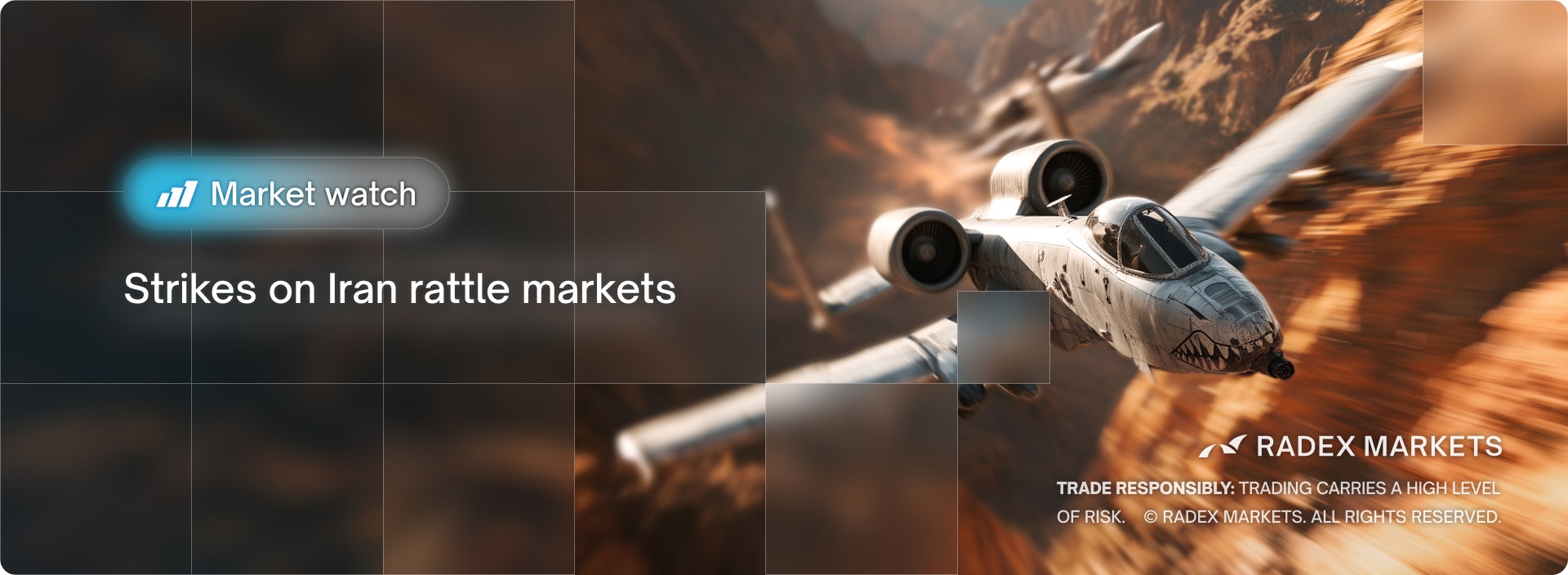
Tensions in the Middle East are flaring up once again and markets are behaving exactly as one might expect. Two super tankers of Saudi Arabian and South Korean origin were struck by projectiles early on Tuesday morning while attempting to transit through the Strait of Hormuz, according to multiple sources. Mere hours later, the US military launched a retaliatory strike against several Islamic Revolutionary Guard Corps targets located across southern Iran. President Trump followed up the attacks by threatening the Iranian regime with more retaliation ‘at a much harder and higher level’. Needless to say, all progress on the peace front has been scattered to the winds and both sides are back to square one. For a brief moment it did look like some kind of arrangement was beginning to emerge, but the last 48 hours have once again made mockery of such optimism.
Crude oil prices inevitably creeped higher on Tuesday as the day’s events unfolded, pushing the Brent Crude benchmark to $95 per barrel. Precious metals were thoroughly unimpressed with the proceedings, with gold falling $120 to a daily close of $4,328 per ounce and silver crumbling back down to $64. Bitcoin held up better than both with a manageable 1.5% decline on the day, bringing the original cryptocurrency down to $77,400 per coin. US markets were still closed when the two super tankers were attacked, leading to a sizeable gap to the downside as trading got underway; the S&P 500 closed the day 0.7% in the red, while the Dow Jones fell 0.8% and the Nasdaq 100 shed 1.3%. Predictably, as the opening bells chimed across Asia early this morning, stock exchanges also opened with moderate gaps in the red, 1.6% in the case of the Nikkei 225 and almost 3% in the case of the Kospi index.
Yesterday, the UK 30-year gilt yield reached 5.9%, the highest level since 1998, while yields on the 10-year gilt hit 5.18%, the highest level since 2008. In Japan, 10-year bond yields touched 3% for the first time since 1996. The US 10-year Treasury note rose to 4.8%, the highest level since January 2025. Germany and France are likewise seeing decade-long highs on their 10-year debt instruments, which are now offering yields not seen since 2011 and 2008 respectively. The entire sovereign bond market is undergoing a pretty severe repricing adjustment, due to a mix of inflation concerns, potential interest rate hikes, and a perceived loss in fiscal responsibility on behalf of the governments issuing said bonds. Either that or someone is expecting the mother of all bull runs to commence any second now.
The month is off to a shaky start, which is all the more worrying considering that September is historically the worst month for stock markets, with the S&P 500 averaging a 1.1% loss since 1928; no other month has an average negative return. There is very little to say about the current state of financial markets that is not tied to developments in Iran, at least until Friday’s NFP report.
About the Author
Lawrence J. came from a strong technical and engineering background before pivoting into a more financial role later on in his career. Always interested in international finance, Lawrence is experienced in both traditional markets as well as the emerging crypto markets. He now serves as the financial writer for RADEX MARKETS.
Reviewed by RADEX MARKETS
Risk Warning: Trading derivatives and leveraged products carries a high level of risk, including the risk of losing substantially more than your initial investment.


Le trading de produits dérivés et à effet de levier comporte un risque élevé et peut entraîner des pertes supérieures à votre investissement initial. Veuillez lire nos Conditions générales (T&C) ainsi que le Product Disclosure Statement (PDS) avant de trader.
CRÉER UN COMPTE