





Financial Analyst/Content Writer, RADEX MARKETS
Lawrence J. came from a strong technical and engineering background before pivoting into a more financial role later on in his career. Always interested in international finance, Lawrence is experienced in both traditional markets as well as the emerging crypto markets. He now serves as the financial writer for RADEX MARKETS.


ACTIONS


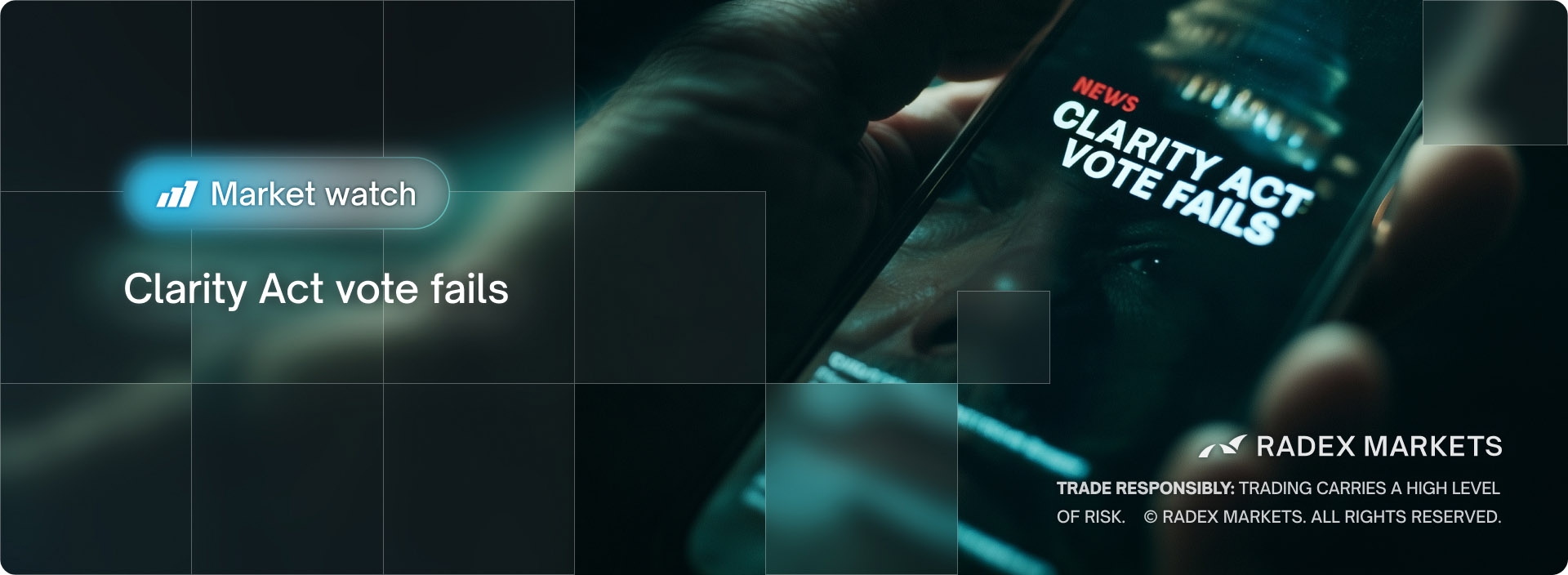
The Clarity Act failed to secure enough votes in the US Senate on Tuesday, realistically stalling the bill for the remainder of the year. Not a single democrat voted in favour, leaving the motion with only 50 votes in total, short of the 60 required for cloture; 3 republicans also voted against. While the result is obviously disappointing for everyone in the cryptocurrency sphere, markets were never particularly optimistic regarding yesterday’s vote. Over the last couple of months, the Clarity Act had been subjected to a myriad of amendments and concessions aimed at appeasing the Democrat party, bumping the bill up to 635 pages in length, but in the end such efforts were in vain. The bill is by no means dead, but there are now only seven weeks left until the November mid-term elections, which will inevitably stall any progress on the Senate floor. Time constraints aside, the bill will need to show at least some signs of bipartisan reconciliation if anything is to happen before the end of the year; so far, half the US government simply isn’t interested.
Another option is that the SEC and CFTC will forge ahead with their own ruleset, bypassing Congress entirely. A lot of work has already been done in this regard, in the form of the SEC’s Regulation Crypto Assets proposal, currently open for public comment until the 20th of October.
All things considered, Bitcoin absorbed the bad news with some degree of composure, closing the day a mere 3% in the red and falling down to the $75k range – barely a scratch in crypto terms. The bigger loses were to be found in crypto stocks, such as Coinbase (COIN) and Circle (CRCL), which fell 10% and 11% respectively following the vote. The lack of progress on the regulation front will undoubtedly hurt the business models of both companies, particularly when it comes to stablecoins and yield-offering services.
With the Clarity Act vote out of the way, attentions will turn to the FOMC meeting later today. A rate hike is all but confirmed at this point, with interest rate traders pointing to a 92% chance of a 25-bps adjustment to the upside. The US dollar reflected the relative certainty of the prediction, moving against the majors and driving the DXY up to 99.6 points by the end of the session on Tuesday.
One decision that may not be so set in stone is the one resting with the Bank of England. Up until the start of the week, markets were confident that the Monetary Policy Committee would hold rates on the pound steady at 3.75%, but recent bond market turbulence has challenged this assumption. Yields on the 10-year gilt hit 5.4% on Tuesday, while those on the 30-year gravitated uncomfortably close to 6%. Talk at the water cooler is that the BoE will also slow down its bond-selling programme, thereby reducing sell-side pressure and giving a chance for yields to settle.
A major factor in rising bond yields, not just in the UK but around the world, is the expectation of higher inflation due to the rise in crude oil prices, which remain at $108 per barrel for Brent Crude. Interestingly, the Shanghai Crude benchmark reached RMB 929.4 ($138.50) yesterday, an all-time record high since the futures contracts launched back in 2018. Very little good news coming out of the Middle East so far this week, particularly in Saudi Arabia, where the state oil company continues to battle to reopen vital pipelines following a wave of Houthi attacks.
About the Author
Lawrence J. came from a strong technical and engineering background before pivoting into a more financial role later on in his career. Always interested in international finance, Lawrence is experienced in both traditional markets as well as the emerging crypto markets. He now serves as the financial writer for RADEX MARKETS.
Reviewed by RADEX MARKETS
Risk Warning: Trading derivatives and leveraged products carries a high level of risk, including the risk of losing substantially more than your initial investment.


Le trading de produits dérivés et à effet de levier comporte un risque élevé et peut entraîner des pertes supérieures à votre investissement initial. Veuillez lire nos Conditions générales (T&C) ainsi que le Product Disclosure Statement (PDS) avant de trader.
CRÉER UN COMPTE