





Financial Analyst/Content Writer, RADEX MARKETS
Lawrence J. came from a strong technical and engineering background before pivoting into a more financial role later on in his career. Always interested in international finance, Lawrence is experienced in both traditional markets as well as the emerging crypto markets. He now serves as the financial writer for RADEX MARKETS.


ACTIONS


While the Anthropic IPO is shaping up to be the biggest story in financial markets this week, a different event, scheduled for very same day, may prove to be far more impactful than anything unfolding on the Nasdaq.
The 33rd Asia-Pacific Economic Cooperation (APEC) summit will take place in Shenzhen over the next two days, and while the purpose of the gathering is to reduce trade barriers and foster greater economic cooperation among member states, the summit will also serve as a convenient venue for talks between the leaders of China, Russia and the United States.
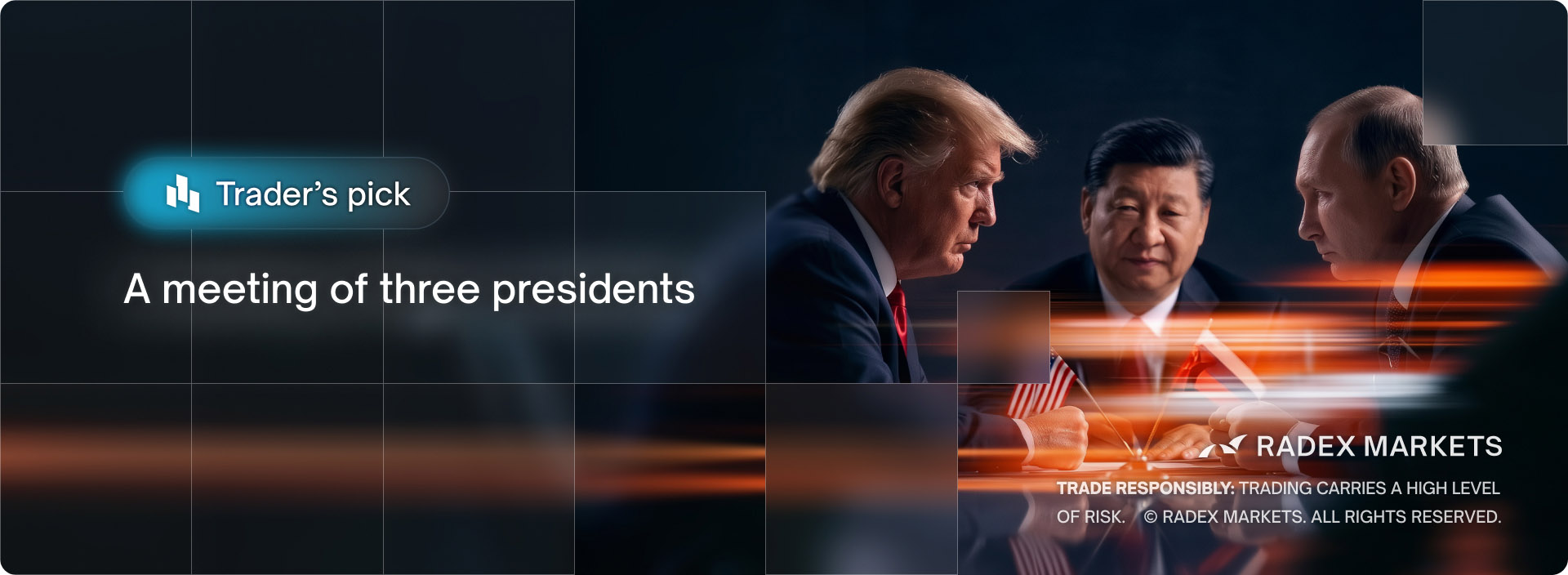
As implausible as it sounds, the trilateral meeting between the three global powers is a historical first. Presidents Trump, Putin and Xi have never sat down at the same table before, nor have any of their respective predecessors. While leaders from the US, Russia and China have attended various events over the decades, such as trade summits or memorial services, at no point have there ever been dedicated talks between the three parties.
Despite taking place during an economic summit, the talks are expected to focus primarily on nuclear controls and disarmament, as well as the ongoing conflicts in Iran and Ukraine. Economics are unlikely to feature prominently during the discussions, with the exception of a predictably straightforward extension of the US-China trade truce, which expires in January 2027.
The event stands out for a number of reasons. Firstly, as discussed above, a meeting between the leaders of the three greatest powers on Earth has not taken place for a substantial amount of time. In fact, observers have drawn comparisons to the Yalta Conference of 1945, during which US President Franklin Roosevelt, British Prime Minister Winston Churchill and Soviet General Secretary Joseph Stalin arguably established the entire global postwar order.
The second element of note is the fact that Vladimir Putin is there at all. Many will see the Russian president’s appearance alongside other leaders as a symbolic end to western diplomatic isolation and an official invitation back to the negotiation table.
The third point is that the European Union and the United Nations are glaringly absent from the discussions, as are nuclear watchdogs such as the International Atomic Energy Agency. While APEC is of no concern to European countries, nor indeed to most of the world, the fallout from the conflicts in Ukraine and Iran have obviously far-reaching consequences in Europe and further afield, as does the international proliferation of nuclear weapons. European and Ukrainian leaders have expressed concern on the matter, as have a number of US allies in the Middle East. Moreover, APEC members have criticised the trilateral meeting for hijacking and overshadowing the economic summit itself.
The final point marks a crucial geopolitical transition. Since 1945, the world has timidly attempted to embrace a rules-based international order, a structure designed to prevent wide-spread military action by locking countries into binding treaties, forcing leaders to forgo conquest and unilateral force in favour of top-down diplomacy dictated by global governance bodies. By the same token, trade regulations have been enforced by the likes of the World Trade Organisation, the International Monetary Fund and the World Bank, in an attempt to level the playing field globally.
Such multi-polar frameworks are an anomaly. Throughout the vast majority of human history, the relationships between different nation states relied exclusively on power projection and spheres of influence. ‘The strong do what they can and the weak suffer what they must’, as the saying goes.
The frustration expressed by many world leaders with regard to the scheduled meeting in Shenzhen may well be a reluctant acknowledgement that the world is returning to the historical norm. The United States, Russia and China will step into a room on Thursday to discuss war, nuclear weapons and global security, and the complaints of those outside the door will fall on deaf ears. The rules-based mirage is rapidly being dismantled, as hard power and political leverage retake their throne. This week’s gathering is far from the only example of this process unfolding in recent years.
It is very unlikely that anything concrete will emerge out of the meeting itself, in fact critics could easily argue that the entire event is merely an exercise in public relations, but Thursday will nevertheless mark a historical turning point. The world is returning to great power politics.
About the Author
Lawrence J. came from a strong technical and engineering background before pivoting into a more financial role later on in his career. Always interested in international finance, Lawrence is experienced in both traditional markets as well as the emerging crypto markets. He now serves as the financial writer for RADEX MARKETS.
Reviewed by RADEX MARKETS
Risk Warning: Trading derivatives and leveraged products carries a high level of risk, including the risk of losing substantially more than your initial investment.


Le trading de produits dérivés et à effet de levier comporte un risque élevé et peut entraîner des pertes supérieures à votre investissement initial. Veuillez lire nos Conditions générales (T&C) ainsi que le Product Disclosure Statement (PDS) avant de trader.
CRÉER UN COMPTE