





Financial Analyst/Content Writer, RADEX MARKETS
Lawrence J. came from a strong technical and engineering background before pivoting into a more financial role later on in his career. Always interested in international finance, Lawrence is experienced in both traditional markets as well as the emerging crypto markets. He now serves as the financial writer for RADEX MARKETS.


ХУВьЦАА


The US blockade of Iran has been reinstated. The global shipping chokepoint that is the Strait of Hormuz has been put under extreme pressure since hostilities began back in March, and as of the 14th of July 2026, the United States has once again restricted all naval traffic to and from Iranian ports. Naval blockades are certainly nothing new, in fact such military tactics emerged very quickly after the first war galleys splashed into Mediterranean waters in the early bronze age, thousands of years ago. Blockades have remained an effective tool of war ever since, spanning many civilisations and many technological eras. But just how effective were such measures in terms of economic reach and overall results? Time for a journey into the past.
The Peloponnesian war was a prolonged conflict for control of Ancient Greece. It pitted a collection of states led by Athens against an alliance of territories led by Sparta. To begin with, Athens was the dominant naval power, whereas Sparta was the major force on land. Given Greek geography, this initially gave the upper hand to the Athenians, who would wield their unrivalled sea power to protect their own trade routes, while raiding and blockading allied Spartan ports, causing economic pressure and even starvation among their enemies.
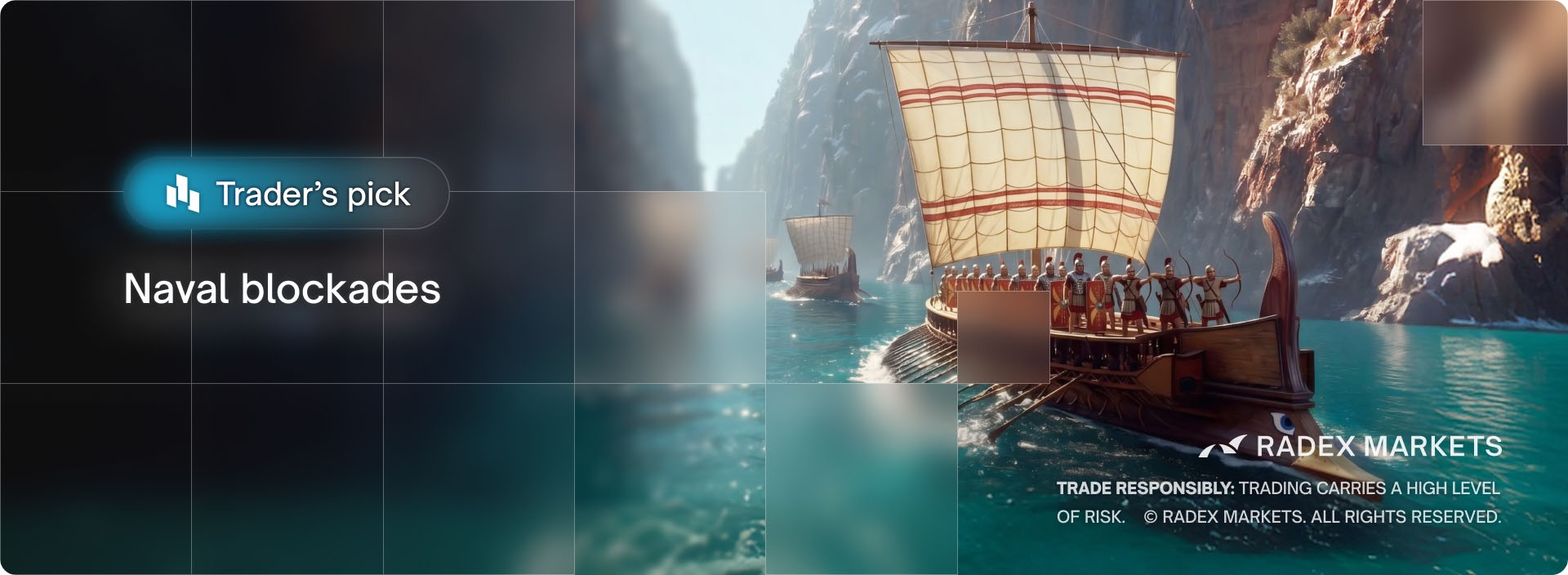
The mighty trireme ruled the waves during this period, an oar-powered galley manned by hundreds of rowers and mounted with a bronze ram at the bow. The vessel was famous for its manoeuvrability and short bursts of speed that could cripple rival ships. It was the battleship of its age and for centuries would strike fear in the hearts of ancient peoples.
As time progressed, Sparta became more effective at naval warfare and would eventually gain the upper hand on the Aegean Sea. The decisive moment occurred when Spartan forces outmanoeuvred the Athenian fleet at the battle of Aegospotami, during which 170 enemy ships were captured or destroyed. With the rival navy scattered to the wind, Sparta was in a position to launch a blockade of Athens itself, controlling the sea on one side and occupying the surrounding lands on the other. The city-state was cut off. Food supplies dwindled. Famine quickly followed. Presented with the choice between starvation and surrender, Athens chose the latter, concluding the final chapter of the war.
Athens lost the war because it was completely reliant on naval shipments of food. As soon as this lifeline was severed, the city state was doomed. Food stores shrank with every passing week, rapidly cornering the leadership of the nation into an untenable position. Starvation is the ultimate expression of economic warfare, making blockades a ruthlessly effective strategy. The naval blockade of Athens was the first well-known example of such; it would not be the last.
While the thousand-year rivalry between England and France has waxed and waned over the centuries, the Napoleonic era was arguably one of the more hostile periods between the two competing powers. In 1803, Britain declared war on France in response to Napoleon Bonaparte’s aggressive territory expansions throughout Europe. Comparisons with the Peloponnesian war are somewhat justified here, with France being the uncontested continental power and Britain being the unrivalled master of the seas.
On the very first day of the war, the Royal Navy deployed hundreds of warships to surround French ports, preventing the French Navy from mustering a coherent force of its own. Three years later, in 1806, the military blockade would evolve into a full containment of France’s northern coast, extending all the way to Germany. This effectively criminalised all trade along one of the busiest commercial shipping lanes in Europe, forcing Napolean to enact measures of economic warfare of his own.
The response from the French Empire was the Continental Blockade, which severed all connections between Britain and continental Europe. The blockade banned British imports and even forbade all forms of correspondence with the British Empire. The system was designed to establish French industrial and commercial supremacy in Europe, from which Britain would be entirely isolated.
The Continental System backfired spectacularly. Although the measures reduced British exports to Europe by half, Britain adapted by turning its gaze further afield, expanding its trade relations to the far corners of the world. Unfortunately for Napoleon, the French economy would not weather the storm so eloquently. The lack of trade with Britain destroyed French port cities; the shipbuilding and ropemaking industries collapsed; the lack of raw materials dealt a huge blow to textiles and sugar refining, while the French state itself suffered massive losses in missing customs revenue due to the lack of trade. Adding insult to injury, because the British Empire still had control of the world’s shipping lanes, smuggled goods often ended up in France anyway, via unofficial, untaxable pathways.
The system would also strain the economies of France’s allies. Portugal and Russia suffered so badly under the Continental Blockade that both countries would eventually refuse to obey the terms therein. Napoleon deployed his armies to quell the dissent, dragging hundreds of thousands of troops into the Iberian Peninsula in 1808, before embarking on the utterly catastrophic invasion of Russia in 1812. The latter defeat ultimately led to Bonaparte’s abdication in 1814, marking the end of the Napoleonic era. The purpose of the blockade was clear, but France lost the war because it lacked the means to properly enforce such an undertaking and suffered irrecoverable losses in trying to do so.
The fall of Napoleon would usher in a century of peace on the European continent, but the engines of war would reignite soon enough. Blockades would play a defining role in the First and Second World Wars, employed liberally by all belligerents to economically and militarily stifle their opponents over the course of both conflicts. The allied blockade of Germany during the First World War would see German exports decline by 60%, causing daily civilian food intake to drop from around 3,000 calories in 1914 to just 1,200 calories by the end of the war. Supplies of fertiliser and raw materials were also cut off, affecting crop yields and forcing the German military to salvage metal from public and private infrastructure alike.
The response was just as devastating. During the same period, German U-boats sank over 5,000 allied and neutral vessels, resulting in the loss of 12 million tonnes of cargo. A third of the world’s merchant ships were destroyed over the course of the war, almost severing Britain’s food supplies entirely and forcing the British government to borrow heavily from the United States. Incidentally, this borrowing would irreversibly shift the financial balance of power away from the British Empire and towards the new continent. The reason New York occupies such a major role in today’s financial world is in part due to the economic circumstances that arose as a result of the First World War.
Blockades would be deployed just as mercilessly two decades later. Just as it did against Napoleon the century prior, the Royal Navy launched a blockade of German territories immediately upon the declaration of war. While Germany had prepared for the inevitable move, heavily stockpiling resources before the conflict erupted, the stranglehold would eventually result in fuel shortages that would grind the German military to a halt. Mirroring its previous efforts, the German U-boat fleet would in turn wreak havoc among British shipping lanes, causing food imports to halve over the course of the war. While living conditions within the British Isles undeniably suffered as a result of these actions, the campaign ultimately failed to starve people into submission.
On the far side of the world, the same military tactics were being employed in an entirely separate theatre. Following the attack on Pearl Harbour, the United States Navy would orchestrate a clinically effective blockade against Imperial Japan, unleashing unrestricted submarine warfare to cripple the island nation’s merchant fleet, sinking over 1,000 vessels in the process. By the end of the war, imports of petroleum and raw materials had plummeted by over 90%, destroying Japan’s ability to maintain military production. Aircraft were no longer built, warships were starved of fuel, transportation ground to a halt, factories sat idle and food supplies dwindled to dangerously low levels. The blockade is widely regarded as one of the most effective campaigns ever conducted.
If trade sanctions are the artillery of economic warfare, then naval blockades are the atomic bomb. Such measures cut down to the bone of supply and demand dynamics, nullifying one side of the equation completely. History has made it abundantly clear that successfully engineering a naval blockade requires nothing short of total command of the sea, as well as an unwavering commitment to see events through to completion, no matter how long that may take. With regard to the ongoing conflict in Iran, nothing has fundamentally changed. When the United States suspended its blockade as part of the short-lasting memorandum of understanding, Iran took the brief window of opportunity to export around 70 million barrels of crude oil. The move significantly weakened one of the blockade’s stated objectives of preventing oil exports from generating revenue for the Iranian regime. The blockade has since been reinstated, but unlike the initial round, it will not be lifted until a comprehensive, permanent treaty has been signed. How long that takes is anyone’s guess. If history is anything to go by, this could take a while.
About the Author
Lawrence J. came from a strong technical and engineering background before pivoting into a more financial role later on in his career. Always interested in international finance, Lawrence is experienced in both traditional markets as well as the emerging crypto markets. He now serves as the financial writer for RADEX MARKETS.
Reviewed by RADEX MARKETS
Risk Warning: Trading derivatives and leveraged products carries a high level of risk, including the risk of losing substantially more than your initial investment.


Дериватив болон хөшүүрэгтэй бүтээгдэхүүнээр арилжаа хийх нь өндөр эрсдэлтэй бөгөөд таны анхны хөрөнгө оруулалтаас давсан алдагдал хүлээх эрсдэлтэй. Арилжаа хийхээсээ өмнө манай Нөхцөл, болзол (T&C) болон Бүтээгдэхүүний мэдээллийн баримт бичиг (PDS)-ийг уншина уу.
ДАНС НЭЭХ