





Financial Analyst/Content Writer, RADEX MARKETS
Lawrence J. came from a strong technical and engineering background before pivoting into a more financial role later on in his career. Always interested in international finance, Lawrence is experienced in both traditional markets as well as the emerging crypto markets. He now serves as the financial writer for RADEX MARKETS.


ХУВьЦАА


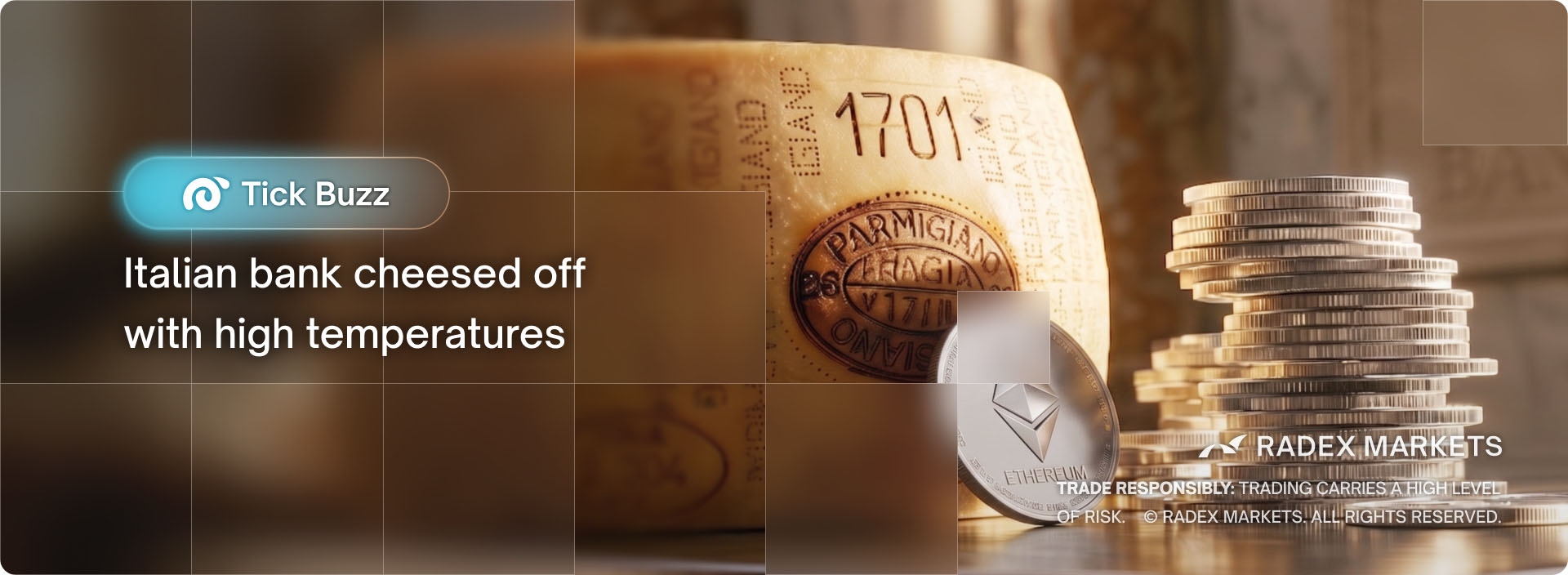
Hidden away within the prosperous northern Italian region of Emilia-Romagna lies a very different kind of treasure. Rather than hoarding precious metals, the huge storage facilities belonging to the Credito Emiliano Bank are instead home to thousands of tonnes of another kind of gold. These perfectly maintained climate-controlled vaults are designed for one purpose and one purpose only: to jealously guard wheel upon wheel of the world-famous Parmigiano Reggiano cheese.
The European heatwave has raged on for months now and north Italy has not escaped the sun’s wrath. Weather conditions are now threatening the bank’s high-tech warehouses, which have to carefully maintain narrow temperature and humidity ranges in order to stop the precious dairy products from drying out or spoiling. Higher outside temperatures are causing electricity bills to swell by 30% in some cases, cutting into the bottom line of a very peculiar business model.
While making premium cheese is a very lucrative business, dairy farmers have to contend with the difficult problem of cash-flow. Because the final product requires 12, 24 or even 36 months of maturation, farmers have no immediate income with which to cover daily operating costs such as cow feed, milking equipment or labour costs. The work being done on any given day may not pay off for several years. The same issue pervades a number of other food and drink businesses, including whiskey distilleries, vineyards and even high-end charcuterie facilities.
This is where Credito Emiliano steps into the equation. Instead of storing its freshly made cheese on site, the dairy farm will deliver the unaged wheels to the bank’s warehouses, where they will serve as collateral for loans, granting farmers the necessary capital to keep their operations running. Credito Emiliano will typically advance 70-80% of the current market value of the cheese, keeping the rest as a buffer against degradation and market fluctuations, making such agreements very low risk for the bank. The loan itself is relatively low interest because of the value and stability of the collateral, meaning the farmers also benefit from the arrangement. A full wheel can easily fetch $1,000 or more, so securing 70-80% of that amount is an effective means of quickly raising a substantial amount of funds.
The technical side of cheese storage is nothing to be sniffed at. The edible gold is stacked from floor to ceiling on shelves reaching up to 10 metres high while automated robots sweep up and down the aisles to delicately brush, clean and turn the massive 40 kg wheels. Each one must be carefully turned over every week to ensure a uniform aging process, thereby ensuring a consistent flavour throughout the hundreds of thousands of cheeses.
The facilities are equipped with state-of-the-art bank-grade security systems, including armoured gates, infrared security cameras, motion sensors and biometric tracking. Climate systems maintain the temperature between 14°C and 18°C and the humidity at around 80-85%. Recent summers have forced the warehouses to undergo a number of upgrades, including modern insulation cladding and dynamic ventilation systems.
The problem for Credito Emiliano is that as temperatures rise, it becomes more expensive to store the collateral, thereby cutting into the profitability of their business model. In some cases, the wheels are stored for up to three years, so a string of hot summers can make a significant dent in the bank’s bottom line. Increased electricity bills are only one element of this; expensive infrastructure upgrades may also be required.
Higher temperatures also affect the cows themselves. Hot cows would rather lie down and sunbathe than tirelessly eat grass all day, which reduces milk yields. Moreover, the milk produced is of lesser quality, characterised by a different fat and protein balance, potentially causing the resulting cheese to fail the strict grading standards. Less cheese produced means less collateral, leading to fewer loans and less revenue for the bank.
The humble dairy industry meanwhile has adopted a futuristic approach to these new problems by turning to blockchain technology. Instead of sending their cheese to the bank’s vaults, farmers store their wheels within their own facilities and implant each one with an edible microchip made out of food-safe silicon. The chips are able to withstand years of acidity and salt at the heart of the cheese and can be read by a hand-held laser scanner that picks up a unique digital ID, which is then stored on an immutable blockchain ledger. Local sensor data are also recorded along with the ID of each cheese, tying each one to detailed environmental records. A non-fungible cheese, so to speak. Should the farm wish to use one of their wheels as collateral for a loan, the ledger will register the cheese in question as a digital asset pledged to the bank. This prevents the stinky business of cross-collateralisation on behalf of the farmer, preventing them from taking out multiple loans on the same cheese.
Credito Emiliano currently handles around half a million wheels of cheese at any given time, equating to around $400 million worth of collateral.
About the Author
Lawrence J. came from a strong technical and engineering background before pivoting into a more financial role later on in his career. Always interested in international finance, Lawrence is experienced in both traditional markets as well as the emerging crypto markets. He now serves as the financial writer for RADEX MARKETS.
Reviewed by RADEX MARKETS
Risk Warning: Trading derivatives and leveraged products carries a high level of risk, including the risk of losing substantially more than your initial investment.


Дериватив болон хөшүүрэгтэй бүтээгдэхүүнээр арилжаа хийх нь өндөр эрсдэлтэй бөгөөд таны анхны хөрөнгө оруулалтаас давсан алдагдал хүлээх эрсдэлтэй. Арилжаа хийхээсээ өмнө манай Нөхцөл, болзол (T&C) болон Бүтээгдэхүүний мэдээллийн баримт бичиг (PDS)-ийг уншина уу.
ДАНС НЭЭХ