





Financial Analyst/Content Writer, RADEX MARKETS
Lawrence J. came from a strong technical and engineering background before pivoting into a more financial role later on in his career. Always interested in international finance, Lawrence is experienced in both traditional markets as well as the emerging crypto markets. He now serves as the financial writer for RADEX MARKETS.


AKCJA


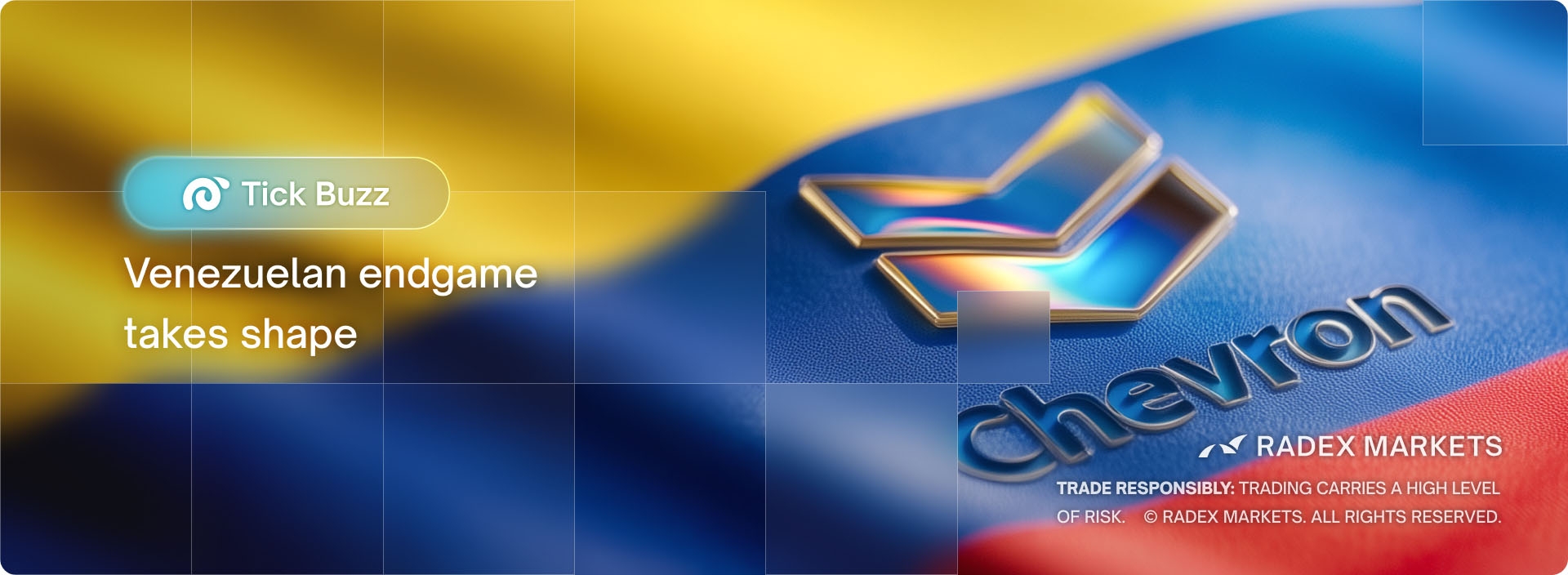
On Wednesday, Chevron (CVX) announced that it will invest $7 billion across its Venezuelan joint ventures in a bid to double oil production to 600,000 barrels per day over the next five years.
Chevron, which first started operating in Venezuela all the way back in 1923, is the only major US oil company still active in the South American nation. Working hand-in-hand with state enterprise Petróleos de Venezuela, S.A., Chevron currently exploits the Orinoco Belt and Zulia State oil fields, located in Central and Western Venezuela, respectively.
As part of the new arrangement, Chevron has been assigned additional acreage in the Orinoco Belt, where the American giant is already well established, possessing a large infrastructure base of pipelines and refining facilities. The new oil fields, designated Carabobo-1 and Carabobo-2-South-A, will provide the new crude oil, which can be drawn out of the ground for under $20 per barrel, according to the company.
The timing of the disclosure is striking, to say the least, arriving only a few days after President Trump announced a separate deal that would give US-backed private operators access to vast swathes of Venezuelan oil fields.
The bilateral deal between the US and Venezuela is far greater in scope, but many details of the arrangement have yet to emerge. The United States has apparently been granted 100-year concessions to operate in 17 separate oil fields, which together account for 65 billion barrels of oil. To put the figure in context, such volumes represent 20% of Venezuela’s total proven reserves, which in turn represent 17% of the entire world’s proven crude oil reserves.
The agreement will operate as a joint partnership between the US government and North American Blue Energy Partners (NABEP), a large private energy company controlled by the prominent Betancourt family. In terms of ownership, the Department of War’s Office of Strategic Capital holds a 35% equity stake, while the US government maintains veto power over appointments to the board of directors and ensures that the entire structure operates under US court jurisdiction. For anyone wondering what on earth the Office of Strategic Capital is, it was established in 2022 and is essentially the investment arm of the Pentagon.
The partnership is expected to invest $100 billion to rebuild and scale up Venezuela’s decaying energy infrastructure, but exactly where this sum of money will come from is one of the fuzzier elements of the arrangement. NABEP estimates that production will ramp up to over 1 million barrels per day once everything is in full swing.
The US will then have a guaranteed right to purchase 20% of all the oil produced by NABEP at production cost, while holding the right of first refusal to buy the remaining 80% in emergency situations. This 20% is expected to replenish the Strategic Petroleum Reserve back in the United States.
One of the fascinating, but somewhat overlooked points about the new deal is that of the seventeen oil fields in question, five were previously exploited by Chinese firms, while one was operated by a Russian company. This becomes more interesting when taken together with reports that Venezuela is considering leaving OPEC. The situation becomes more interesting still when taking into account rumours that Venezuela could abandon its currency, the bolivar, in favour of the US dollar. Whether the latter eventualities materialise or not, the display of hard power is hard to ignore.
The broader picture is becoming increasingly clear. Operation ‘Absolute Resolve’, carried out on the 3rd of January this year, was a clinically precise manoeuvre that resulted in the successful capture and extraction of Venezuelan President Nicolás Maduro. Nine months later, the operation is looking less like an isolated event and more like the opening chapter in a longer-term play. The US has seemingly secured a golden stake in over 3% of the world’s known crude oil reserves, while pushing out its main rivals in the process.
In theory anyway. The reality on the ground may prove more frustrating. Venezuela is not an easy country in which to do business, at least not in this century. Legal battles aside, the $100 billion investment pledge will prove crucial to get the ball rolling and so far, it is not obvious who will foot the bill.
About the Author
Lawrence J. came from a strong technical and engineering background before pivoting into a more financial role later on in his career. Always interested in international finance, Lawrence is experienced in both traditional markets as well as the emerging crypto markets. He now serves as the financial writer for RADEX MARKETS.
Reviewed by RADEX MARKETS
Risk Warning: Trading derivatives and leveraged products carries a high level of risk, including the risk of losing substantially more than your initial investment.


Handel instrumentami pochodnymi oraz produktami lewarowanymi wiąże się z wysokim ryzykiem i może prowadzić do strat przekraczających wartość początkowej inwestycji. Przed rozpoczęciem handlu należy zapoznać się z naszymi Warunkami i Zasadami (T&C) oraz Dokumentem ujawniającym informacje o produkcie (PDS).
OTWÓRZ KONTO