





Financial Analyst/Content Writer, RADEX MARKETS
Lawrence J. came from a strong technical and engineering background before pivoting into a more financial role later on in his career. Always interested in international finance, Lawrence is experienced in both traditional markets as well as the emerging crypto markets. He now serves as the financial writer for RADEX MARKETS.


SHARE


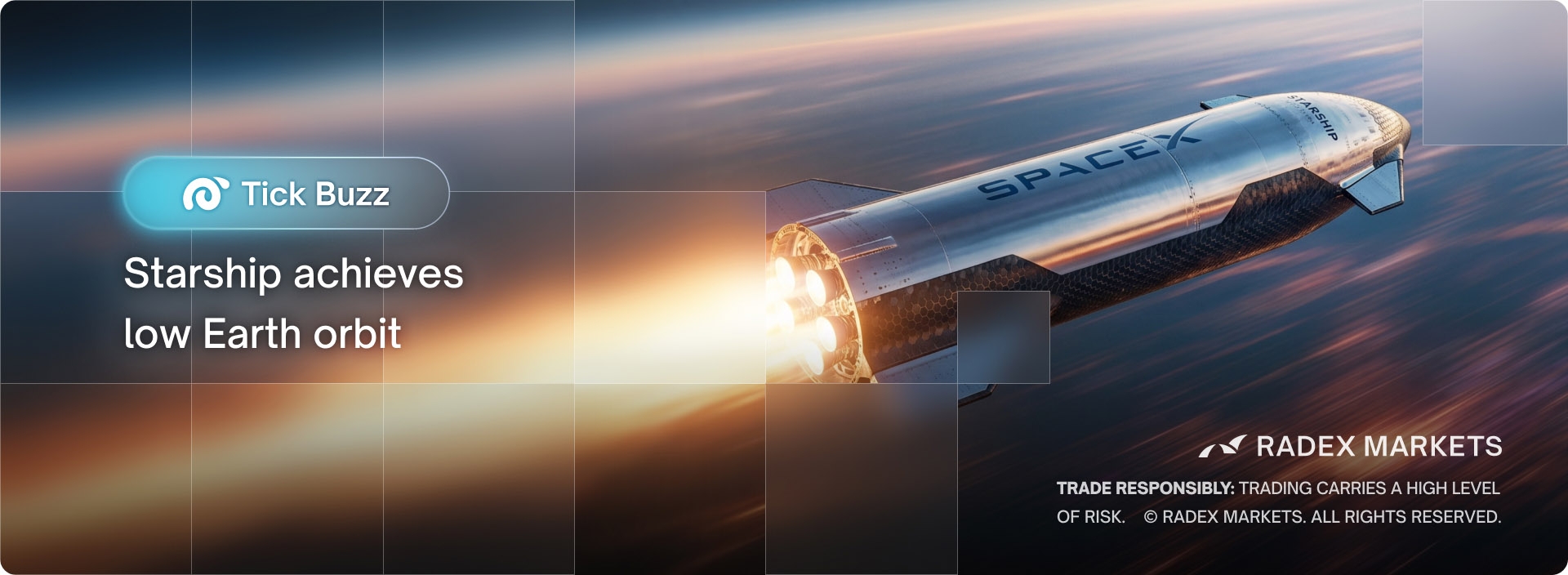
On Monday, SpaceX (SPCX) successfully launched its Starship spacecraft into low Earth orbit, using the system to deploy 26 next-generation Starlink V3 satellites.
The latest flight established two novel achievements for SpaceX. While Starship has experienced many successful launches in the past, this is the first time the spacecraft has executed an orbital insertion burn, pushing it to a stable altitude of 275 km. All previous test flights intentionally followed sub-orbital trajectories designed to bring the spacecraft straight back down to Earth.
It is also the first time the system has carried real cargo into space – all previous flights transported only test items – meaning that Starship is now a fully-fledged orbital launch vehicle.
The original mission was to circle the planet six times as part of a 10-hour flight, but after Starship lost one of its six raptor engines, flight control decided to cut the journey short, reducing the trip to just three hours and two orbits.
The re-entry manoeuvre was equally fruitful, protecting the integrity of the craft during the de-orbiting process, before splashing down on target in the North Pacific Ocean.
With yesterday’s operation successfully completed, the next goal for SpaceX will be to recover the Starship as it re-enters the atmosphere, snatching it in an upright position as it makes its way back to Starbase in Texas. This manoeuvre has already been carried out on the booster component of the rocket, but up until now the upper stage Starship has not been recovered in such a manner.
SpaceX still has a long way to go before achieving its ultimate goal of ferrying humans to mars, but this week’s flight is undoubtedly a big step toward that end.
The colossal size of the new Starship spacecraft allows it to deliver far greater payloads than its predecessors, the Falcon 9 and the Falcon Heavy. While the Falcon 9 had a maximum payload of 23 tonnes, and the Falcon Heavy 64 tonnes, Starship can handle over 100 tonnes of cargo per launch.
At 124 m tall, Starship dwarves everything that came before it, even surpassing the monstrous Saturn V rockets used in the Apollo missions back in the late 1960s and early 1970s. Even more remarkably, the latest propulsion system generates twice the amount of thrust on liftoff and is completely reusable.
Current estimates for cost per launch sit at around $100 million, but this figure is expected to fall drastically as each component becomes increasingly reusable
When it comes to the economics of getting cargo into orbit, the only figure that matters is the price per kilogram.
Historically, this figure has been astronomically high. Massive investment costs and largely expendable hardware pushed expenses through the roof, making launches so prohibitively expensive that they remained exclusively in the hands of major global governments.
From the early 1960s onwards, costs typically remained around $50,000 per kg. This figure would remain constant until the mid-2010s, after which SpaceX and the Falcon 9 rocket single-handedly changed the game forever.
The reusable nature of the Falcon 9 brought costs down to around $3,000 per kg. The Falcon Heavy reduced them even further, to under $2,000 per kg in the present day.
As it turns out, there is a great deal of demand for cheap space freight, and SpaceX has been all too happy to accommodate the surge in growth. The company orchestrated a total of 165 Falcon flights last year, accounting for more than half of all launches globally.
It costs a lot of money to build a new rocket. By reusing existing hardware, these costs come down dramatically. One particular first-stage Falcon booster has completed no fewer than 37 separate launches and is still in service today. SpaceX aims to make this the norm.
Orbital freight costs are far lower than they have ever been, and yet Starship aims to slash them further still, eventually reducing the price tag to just $100-200 per kg.
Despite the technological leap, financial markets were not impressed, dragging SPCX shares 2% lower by the daily close.


การซื้อขายตราสารอนุพันธ์และผลิตภัณฑ์ที่มีเลเวอเรจมีความเสี่ยงสูง และอาจทำให้เกิดผลขาดทุนมากกว่าเงินลงทุนเริ่มต้นของคุณ โปรดอ่านข้อกำหนดและเงื่อนไข (T&C) และเอกสาร Product Disclosure Statement (PDS) ก่อนทำการซื้อขาย
เปิดบัญชี