





Financial Analyst/Content Writer, RADEX MARKETS
Lawrence J. came from a strong technical and engineering background before pivoting into a more financial role later on in his career. Always interested in international finance, Lawrence is experienced in both traditional markets as well as the emerging crypto markets. He now serves as the financial writer for RADEX MARKETS.


ХУВьЦАА


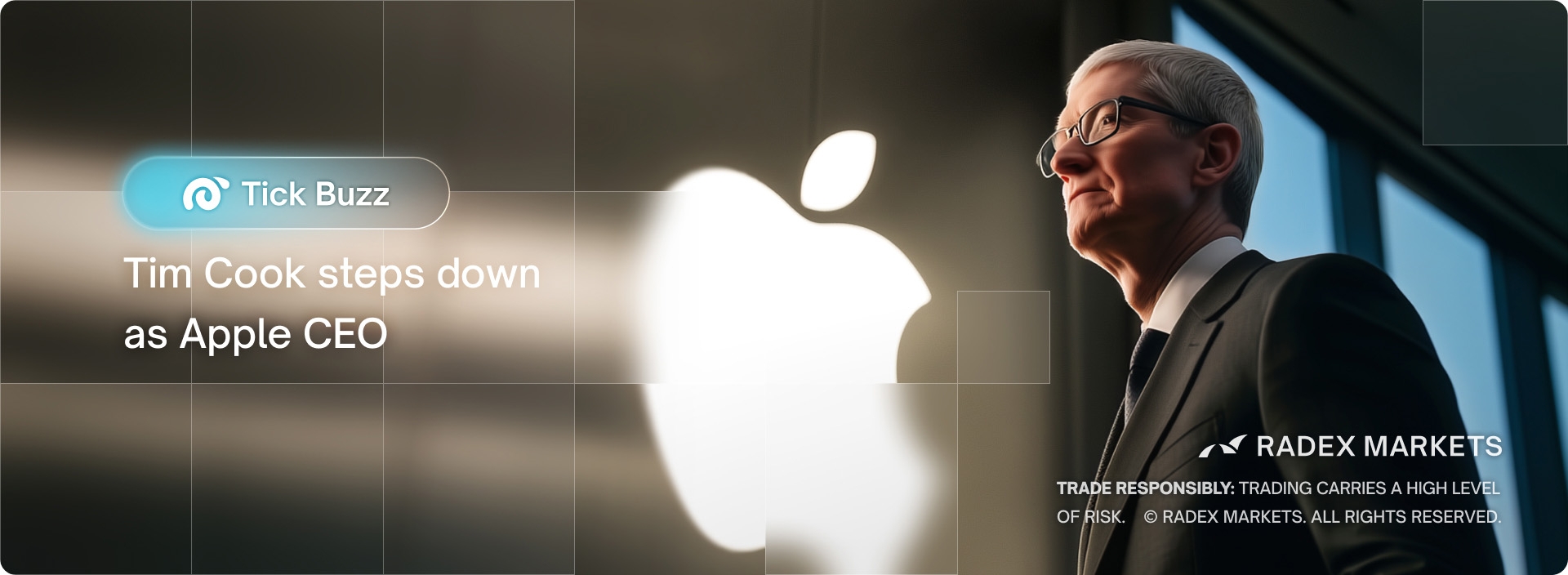
On Monday, Tim Cook stepped down as CEO of Apple after fifteen years at the helm of the company.
In a heartfelt message to Apple employees, Cook quoted the late Steve Jobs, saying that the company ‘made it possible to leave our “dent in the universe” […] because of who we are and what we believe, because of what we value and how we see the world. How fortunate we are. How fortunate I am’.
John Ternus, Apple’s senior vice president of hardware engineering, will now take on the role of CEO, while Tim Cook will remain on as executive Chairman.
Cook first joined Apple back in 1998 after being asked to join the company by Steve Jobs. His first position was that of senior vice president for worldwide operations, which he would hold until 2009, after which Cook was promoted to lead operations. Over the next two years, as Jobs’ health continued to deteriorate, Cook took on a more active role in day-to-day operations, before officially replacing the former CEO in August of 2011, six weeks before Steve Jobs sadly passed away as result of complications from pancreatic cancer.
It may be hard to comprehend today, but back in the mid-1990s, Apple was financially struggling due to a bloated product line and severe mismanagement. In 1997, Apple reported a net loss of over $1 billion and was estimated at one point to be only 90 days away from bankruptcy. Co-founder Steve Jobs rejoined the company during that same year, managed to secure a $150 million lifeline from none other than Microsoft, consolidated production efforts on a much smaller number of commercial ventures and eliminated many failed projects.
While Jobs was the visionary giving newfound momentum to the company, Tim Cook was the financial architect that stopped Apple from bleeding to death. Supply chain management, distribution, logistics and manufacturing were all streamlined, leading to a system where idle inventory became almost non-existent. Hardware was assembled and shipped as quickly as possible, creating the ‘just-in-time’ manufacturing model that freed up millions in spare cash. By securing massive contracts with its various suppliers, Apple was also able to lock in stable supplies of components at lower prices than its competitors.
In 1998, Apple recorded a net income of over $300 million, the first profitable year since 1995. The following year, in 1999, net income doubled to $600 million. Unfortunately, the dot-com bubble burst at the tail end of the year 2000, killing the upward momentum and causing the company to eat a loss of $25 million in 2001. This would be the last time Apple failed to turn a profit.
Over the following years and decades, Apple gradually became the unstoppable behemoth we have all come to recognise. In 2007, the year the first iPhone launched, net income hit $3.5 billion; by 2010, this had quadrupled to $14 billion; in 2020, $57 billion. Over the last twelve months, Apple has recorded net profits of nearly $130 billion, while the company’s market cap has surpassed $4.5 trillion – the second largest in the world after Nvidia.
Apple’s transformation is one of the greatest financial success stories the world has ever seen, and Tim Cook was at the heart of it from the very beginning. To say that he succeeded in his role is a huge understatement. He was instrumental.
For clues as to what the future holds for Apple, one could do worse than to look at the incoming CEO John Ternus. Far from a typical boardroom executive, Ternus is a mechanical engineer by trade, who spent his entire career climbing the internal ranks inside Apple. For decades, his job has been to build the products for which Apple is now famous. Well respected by the rank-and-file of the company, John Ternus is the kind of person who spends hours arguing about the number of threads on a screw that no one will ever likely lay eyes upon.
The shift from economic efficiency to product design and engineering is intentional. Apple has financially dominated for a generation; the new appointment suggests that the company’s focus will turn back to the products themselves and away from the bottom line. It is fair to say that Apple is no longer the cultural pioneer it used to be; one might even accuse the company of being somewhat boring in recent years.
With that said, most companies are in no position to make such a transition. The fact that Apple is able to pivot back to its roots so readily is all down to the financial flexibility afforded by the actions of Tim Cook.
About the Author
Lawrence J. came from a strong technical and engineering background before pivoting into a more financial role later on in his career. Always interested in international finance, Lawrence is experienced in both traditional markets as well as the emerging crypto markets. He now serves as the financial writer for RADEX MARKETS.
Reviewed by RADEX MARKETS
Risk Warning: Trading derivatives and leveraged products carries a high level of risk, including the risk of losing substantially more than your initial investment.


Дериватив болон хөшүүрэгтэй бүтээгдэхүүнээр арилжаа хийх нь өндөр эрсдэлтэй бөгөөд таны анхны хөрөнгө оруулалтаас давсан алдагдал хүлээх эрсдэлтэй. Арилжаа хийхээсээ өмнө манай Нөхцөл, болзол (T&C) болон Бүтээгдэхүүний мэдээллийн баримт бичиг (PDS)-ийг уншина уу.
ДАНС НЭЭХ